

A New Anthology by Onkar Ghate: "The Moral Idealism of Ayn Rand"
ARI’s top philosopher explores the relationship between Ayn Rand’s philosophy and her novels

In a 1961 interview, Ayn Rand was asked whether she considered herself primarily a novelist or a philosopher. “I would say I am primarily both, equally and for the same reason,” she replied, explaining that her purpose in both fields was “to define and present an ideal man, the specific, concrete image of what man can be and ought to be.” Nevertheless, readers often approach Rand’s philosophy mainly through her nonfiction writings. In doing so, they gain only an incomplete grasp of her philosophy.
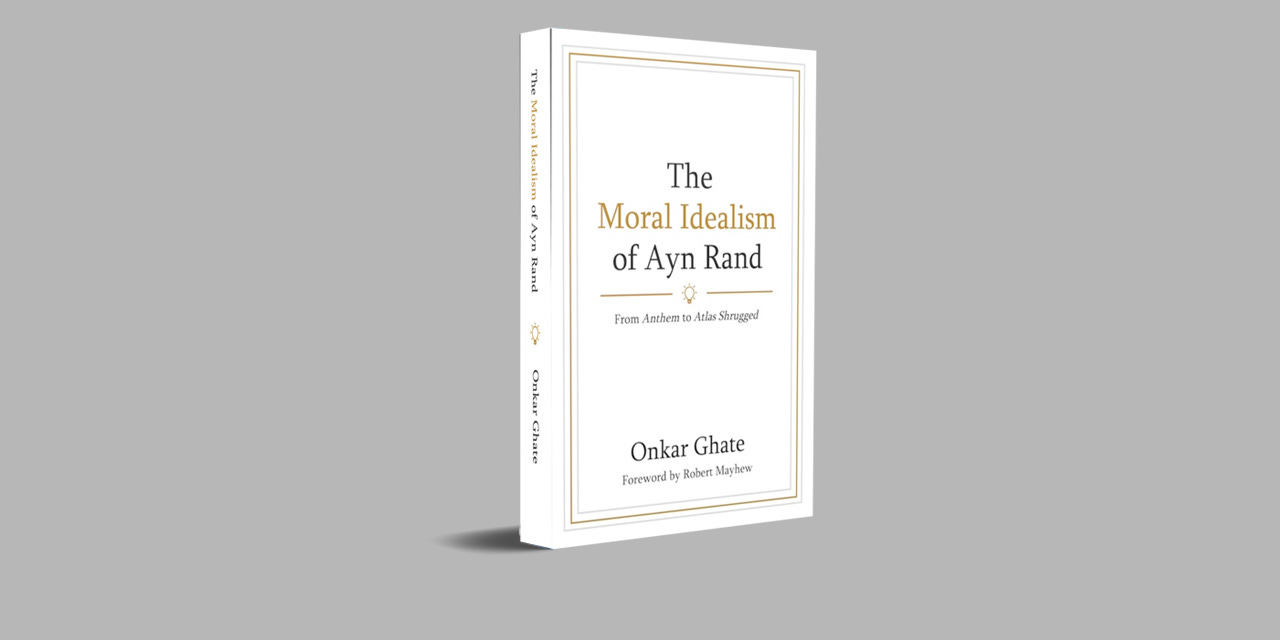
To help readers gain a more complete grasp, ARU Press is pleased to announce the publication of The Moral Idealism of Ayn Rand: From “Anthem” to “Atlas Shrugged,” a new anthology of essays by Onkar Ghate, ARI’s chief philosophy officer. The book debuted on June 27 during Tal Tsfany’s State of ARI presentation at OCON 2026.
As Robert Mayhew, a leading scholar of Rand’s fiction, writes in the foreword to the anthology, there is an “intimate and inextricable connection between Ayn Rand’s philosophy, Objectivism, and her novels.” Indeed, “in order to understand [her] views on such philosophical issues as free will, reason and emotion, and self-esteem, it is not enough to read her nonfiction; one must attend to her novels.”
Ghate does more than just attend. In eight essays, his volume examines how the heroes in Rand’s fiction strive to embody her moral ideal, translate it into action, and confront a world hostile to their values. For example, Ghate shows how, in Anthem, Equality 7-2521’s discovery of electricity leads him to grasp that his own mind is free and self-governed, breaking collectivism’s metaphysical hold over him. Turning to Atlas Shrugged, he argues that Dagny Taggart’s first ride on the John Galt Line shows her recognizing the “unity of spirit and matter,” that spiritual values should be made real in the material world through purposeful action. Likewise, Ghate examines Leo Kovalensky’s decline in We the Living, showing that even a man of real virtues can be spiritually destroyed if his devotion to life never fully develops.
While Rand’s novels are deeply philosophical, Ghate stresses that this does not make them didactic. In the opening chapter, he challenges the familiar charge that Rand’s fiction is “a conference talk, a classroom lecture, a sermon disguised as a novel,” arguing that such objections rest on faulty categories. Rand’s aim, Ghate explains, was to create “a new kind of story,” one in which the “discovery of philosophical principles drives the plot.” In Anthem, for instance, Equality 7-2521’s rediscovery of himself as an individual drives the actions he takes, the conflicts he enters, and ultimately makes his triumph possible.
The final chapter broadens the point that Rand’s fiction is not didactic through an analysis of John Galt’s speech in Atlas Shrugged. According to Ghate, far from being “a digression” or “a pause in the action,” the speech is crucial to the novel’s plot and theme. As part of the producers’ strike, it is itself an element of the novel’s action. Further, by articulating the principles behind the strike, Galt explains the actions of the characters, from Francisco d’Anconia’s destruction of his own copper empire to Dagny’s search for the destroyer behind it all.
The Moral Idealism of Ayn Rand is available now on Amazon in paperback and Kindle, with an audiobook to follow soon.
Will this be on Apple Books?