

Read the New Afterword to the Archival Edition of "Screen Guide for Americans"
Michael S. Berliner traces Ayn Rand’s path from a Soviet movie diary to testifying before Congress about Communist propaganda in Hollywood
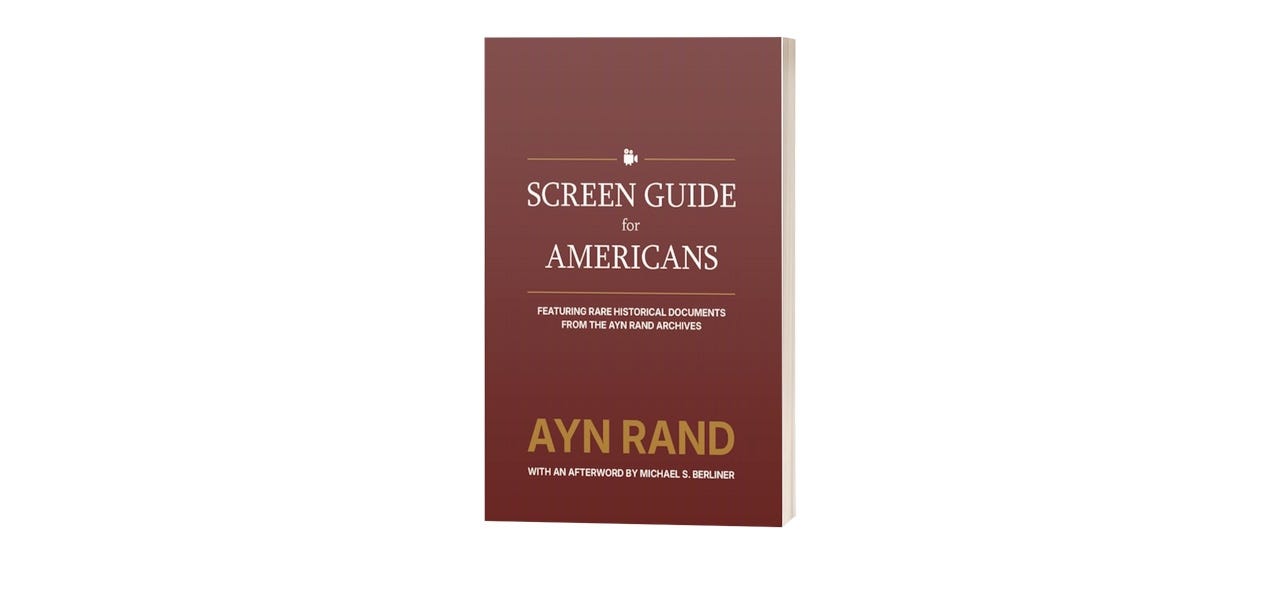
In the aftermath of Nazi Germany’s defeat in World War II, collectivism was still very much alive. Soviet Russia, America’s wartime “ally,” was now its greatest enemy — but one that was more intellectual than military. Ayn Rand’s screen guide, now available for the first time as a book, was written and produced in 1947 as a warning about this ally and its subtle ways using films to undermine America and the individualism it represented. This first archival edition of “Screen Guide” is supplemented by an 11-page afterword by founding CEO of ARI, Michael S. Berliner, providing important historical background from Ayn Rand’s life and career. The Ayn Rand Institute is pleased to reprint the afterword.
The Screen Guide exemplifies the convergence of two significant aspects of Ayn Rand’s life to that point in time: film and political ideology.
Ayn Rand’s Connection to the Film Industry
Films played such an important role in a 30-year period of Ayn Rand’s life that a mini-biography can almost be written by tracing her connection to films, beginning with her mid-teens up to the publication of her “Screen Guide,” when she was in her early 40s. Although she may have attended foreign films earlier, that period officially starts in the winter of 1922 with the first entry in her movie diary, D.W. Griffith’s Intolerance. That diary was an ongoing list of movies she attended between 1922 and 1929. It was so important to her as a documentation of her movie-going that she had her sister Nora reproduce the contents in letters to Rand, who had, for reasons unknown, not brought it with her to America. Nora began incorporating that list into her letters apparently just a few days after Rand arrived in America. Rand then copied the information into a small notebook.1 Each entry contained the film title, her grade for the film, the date and theater, the director, and the principal cast. Nora concludes the list with: “That’s the end!!! Well, aren’t I the most heroic person in the world? The Crusades were child’s play compared to my labors here. To recopy 170 movie entries! . . . I curse the Technicum for giving you free passes.”
The “Technicum” to which Nora referred is the State Technicum for Screen Arts, a school created by Soviet dictator Vladmir Lenin to advance Soviet film. Hoping to learn screenwriting, the 19-year-old Alisa Rosenbaum enrolled in the Institute in the fall of 1924, but she attended for only one academic year: Before she could take courses on screenwriting, she received an invitation to visit relatives in Chicago.
And it was likely that writing assignments at the Technicum marked the start of her writing career. Her first two published works were film-related booklets, both written in 1925: “Pola Negri,” and “Hollywood: America’s City of Movies.”2 Since these were both written before she came to America, her likely source of information was movie magazines that her Chicago relatives were sending to her.
But it was the content of Western films that had such great impact. Operettas (particularly those by Emmerich Kálmán) had been her main inspirations and windows on the West, but, as she put it in her 1960–61 biographical interviews: “movies supplanted the operettas in my life . . . because that was a much more specific, not merely symbolic, view of life abroad . . . . I began to see movies every night practically. And that was the most wonderful period. For Russia that was one of my happiest periods as such. I don’t mean in the total, but at least in this aspect: because it was almost as if I had a private avenue of seeing the world outside. So that those movie stars and movie magazines from abroad became, well, the world from Mars, the voice from Mars.”3 What those films showed of America was especially inspiring: “There were some American movies where you could see New York, just shots, usually long shots, and I would sit through two shows just to catch it . . . and it seemed completely incredible. I can’t tell you how glamorous it was at that distance.” That glamor inspired a goal for the teenage Alisa Rosenbaum: get to America and never return.
When she arrived in “Mars,” on February 19, 1926, she stepped — at first indirectly and then directly — into the film world. In Chicago, Sarah Portnoy, matriarch of one of the two families of relatives with whom she stayed, owned the New Lyric Theater, a movie house on Chicago’s South Side, which Ayn Rand attended almost daily: she saw 234 films in 183 days.
When she wasn’t going to films, she spent her time writing scenarios, as she later related:
Now, the first six months, you see, I had to spend here writing those stories, learning to speak English, and then I had decided that I would go to Hollywood, because I couldn’t yet hope to write in a literary English. I had figured out that, since this was the day of the silent movies, I could write — even if it’s slightly broken English — enough to write an outline, the scenario, just the original of a story, and then somebody else could write the titles. . . . It was putting things in reverse, because, you know, in Hollywood you have to make a name for yourself in some other branch of writing before you go to Hollywood, but I reversed it.
So, after those six months in Chicago, she took the train to Los Angeles, bringing with her an introduction to the publicity department at the studio of Cecil B. DeMille, her favorite American director. Then, on September 4, 1926, her first full day in California, came the “fairy-tale” event of her life: Headed to DeMille’s studio in Culver City, she took the right bus line but in the wrong direction, and it was that fortunate mistake that enabled her to launch her early film career and indirectly to meet her future husband. She finally got on the correct bus to Culver City but arrived later than expected at the studio. After submitting her letter of introduction and getting a perfunctory response, Rand prepared to return to Hollywood, where she had a room at the Hollywood Studio Club, a residence for young women seeking careers in the film industry. Then, in her own words, “Now I walk out of the studio . . . and it has a driveway in front of the main building that goes to a gate. And as I start [to] walk down that driveway, I see an open roadster parked, and a man at the wheel talking to somebody outside the car, and it was DeMille. . . . I was just stunned, because it was such a lucky coincidence.” Because she had taken the wrong bus, she caught DeMille on his lunch break. “I recognized him from pictures I had seen. And I stood there staring at him. . . . So I walked on to the gate, and I stopped at the gate to wait to see him drive by. And it wasn’t too long before he started driving. He drives up to the gate, stops, looks at me, and asks, ‘Why are you looking at me?’ Very, very pleasantly. Apparently he had noticed me before. So I told him I had just come from Russia and I am very happy to see him. So he opens the door of the car and says, ‘Get in.’ I didn’t know where we were going; I got in and he started driving. Now isn’t that a fantastic story?”
The story doesn’t end there, for DeMille drove her to the backlot, where they were shooting crowd scenes for his epic King of Kings. In the car, DeMille told her “If you want to work in pictures, you should begin by watching how they work on the set and by observing and learning, so this will do you good.” He then gave her passes for two days, hired her as an extra and eventually as a junior screenwriter. Her career was off and running, and so, ultimately, was her romantic life: On her second or third week at the DeMille Studios, she spotted Frank O’Connor on an early-morning streetcar from Hollywood to Culver City, sought him out on the DeMille set, where he was also working as an extra, later ran into him by chance at a Hollywood library, and married him in April 1929.
After the DeMille Studios closed in 1928, Rand got a job in the wardrobe department at RKO, a job that supplied an income while she wrote We the Living. She lived across the street in an apartment building where she met producer David O. Selznick’s assistant, who gave her the idea for Peter Keating, the second-hander, whose character type features so prominently in The Fountainhead. (Rand’s original title for the novel was “Second-Hand Lives.”) After moving to New York City in 1934, she worked for Paramount Studios, reviewing books submitted to the studio for possible adaptation. Then, after The Fountainhead was published in 1943, she returned to Hollywood to write the screenplay for the film version to be produced by Hal Wallis, who was fresh from his success producing the classic Casablanca. It was upon her return that she became involved with pro-free enterprise people in Hollywood, in particular the Motion Picture Alliance for the Preservation of American Ideals (MPA).
Ayn Rand’s Political Activism
Ayn Rand’s history with politics and political philosophy hardly needs recounting. She witnessed the start of the so-called Kerensky Revolution in February of 1917, and, when 12 years old, adopted the anti-Bolshevik Alexander Kerensky as her hero (downgrading him to “mediocrity” when she met him in 1945). Then, in her mid-to-late teens, she began having political discussions with her father, whom she described as favoring individualism and free enterprise. Although she made anti-Soviet entries in her diary, she kept those ideas secret, knowing that they could be a death sentence. But when she came to America, she became active in politics, working in the 1940 Willkie presidential campaign, writing her “Individualist Credo” and “Individualist Manifesto” and working to form what she called “The Individualist Organization.” Particularly daunting and motivating was her shock at the state of American politics. When she was writing We the Living, she expected that the prevalent view of Communism would be the same as hers. As she explained in her biographical interviews:
Did I know the degree of Pink penetration in America? No. I had no idea of it. I did not know very many people in Hollywood, but those I knew were certainly not Left. And I did not have the impression of the enormous prevalence of Pink sympathizers. Now remember, this was before the New Deal, when the novel was started. And Russia was not even recognized. I did not follow politics or New York publications closely enough to see any particular Pink trend. And I do believe, in retrospect, that it accelerated enormously after 1933, after Roosevelt. . . . My impression, more than anything else, was that people are not sufficiently aware of the menace and the evil of Communism, but that they would be in sympathy with it, I didn’t expect. . . . I took for granted that nobody, except the worst kind of hypocrites, can ever be or advocate altruism.
Still a relative newcomer to America, Rand did not know that the Red Decade had arrived, that period in American history when reverence for the “Soviet experiment” was at its highest.
The Screen Guide
Ayn Rand was not the only anti-Communist in Hollywood. Formed in 1944, the MPA’s membership included DeMille, Gary Cooper, Clark Gable, Barbara Stanwyck, Hal Wallis, and John Wayne. For a short time, Rand was on the executive committee. The MPA organized the writing of “Screen Guide,” which was published over the group’s name in its newsletter, “The Vigil.” Details of the publishing history and Rand’s dealings with the MPA can be found in Robert Mayhew’s Ayn Rand and Song of Russia.
If We the Living can be considered a promise kept to the family friend who urged her to “tell the rest of the world that we are dying here,” then “Screen Guide” can be considered a similar warning. She was telling moviemakers and moviegoers to beware of unknowingly absorbing dangerous ideas — not beware of the Communist Party but of altruistic/collectivist ideas that pervade the motion pictures. The Ayn Rand Papers, housed at the Ayn Rand Archives, contain clippings from major newspapers (including the New York Times) with stories announcing the publication of the guide. These stories are by-lined news stories that summarize “Screen Guide,” including numerous quotes and stressing the MPA’s support of freedom of speech.
Ayn Rand’s Assessment
Let Ayn Rand continue the story about the guide’s impact:
This was just about the time of the Hollywood hearings. And, originally, two men from the Thomas Committee — that was the House committee investigating it — came to Hollywood to interview conservatives. And what they wanted mainly was only factual, journalistic material about penetration of the Director’s Guild, the Screenwriter’s Guild, and things like that. All facts. Well, I had nothing to do with any of it. I didn’t belong to the Writer’s Guild. But, at that same time, the FBI was helping them to investigate, and they attended some of our meetings, of the Board.4 And they had heard about the “Screen Guide for Americans.” It was interesting to me that they had heard it before it was out. And asked us for galleys of it, just for their own interest. Which we supplied. It was just being finally put into booklet form then. And about a week later, I got a call from those investigators that they wanted me to come to Washington to testify on the ideology of films. So, I’m sure it was connected. I later learned that the galleys or some report on it had gone to one of the chief investigators for the Thomas Committee, who was an ex-communist, but of thirty years ago, or something like that. And he was their expert on Communism. He had been urging them to do something ideological for years. And when he saw a report on this booklet, he is the one who urged that I be brought to testify. [I was willing to testify] to bring it out into the open. So long as there was a chance, it would have been the only forum. The real reason why I felt it would be all right, and the real good that I accomplished was this: prior to that hearing there would have been no way to get anything about it into any newspaper or magazine. The idea of Hollywood penetration was hopeless ideologically. As I said, there were quite a few articles appearing about Reds in Hollywood but never about propaganda on the screen. That was the real issue, you see, the touchy issue for Hollywood. And incidentally, the producers and all were quite willing to let it be discussed that there were a few communists around. But it’s the content of movies that they did not want to touch. I suspect partly because the Red pressure would have been on that, partly because they were all scared to death of not knowing how to handle those issues and didn’t want to be involved in ideological disputes. Now, the good that that hearing accomplished is that that was the turning point for Red propaganda on the screen. It vanished after that completely. And then later, a few hints kept coming back, but so feebly and so subtly that only Party members would ever know it. I mean it was too feeble to do any harm to the general public. And there I take credit, for the “Screen Guide for Americans” did it. Now, the best thing was that that “Screen Guide” (in condensed form, but the most important highlights) was reproduced in the drama section of the Times,5 the Sunday Times front page, you know, the drama section, which there would be no way of getting to, except in connection with this hearing. . . . Several other newspapers across the country did the same. My name, you know, is not on it, because it was written for the organization. But one magazine, Plain Talk, reprinted the condensed form without permission, with my name on it.6 And that was the best accomplishment. Then, at first, when the “Screen Guide” came out, the major studios generally kind of ignored it. Progressively, thereafter, I began hearing one studio and another ordering it from the MPA in tens and dozens. And all the points that I made in it — particularly, you know the attacks on the businessmen as villains — disappeared, certainly in the form in which they had been. If you watch old movies on TV, you’ll see the difference. And there I really take credit for it.
The format of the guide is a list of “don’ts,” addressing Conservatives in general but film producers in particular, urging them not to sanction ideas and positions that are destructive of their ideals. Thus “Screen Guide” was not merely a warning about the subtle ways that collectivist ideas are spread. As a call not to support one’s enemies, it was her first public statement about moral sanction, a principle integral to the story of Atlas Shrugged (a crucial insight of the novel’s hero is that “I saw that there comes a point, in the defeat of any man of virtue, when his own consent is needed for evil to win — and that no manner of injury done to him by others can succeed if he chooses to withhold his consent”). This principle was the theme of Rand’s last public talk, “The Sanction of the Victims,” where she implored businessmen to cease financing universities that are the source of collectivist and thus anti-America ideas. It is, she said, “a moral crime to give money to support your own destroyers.”
By the late 1940s, Rand began to cut her ties to the film industry. She had resigned from the executive committee of the MPA, The Fountainhead film had been released in 1949 and had moved the novel back onto the bestseller lists, and she and Frank moved permanently back to New York City in 1951. One final confluence between political ideology and film was her editing for re-release of the newly rediscovered Italian film of We the Living. Produced illegally (i.e., without Rand’s permission) in 1942 in Fascist Italy, a print was discovered in 1968, and Ayn Rand worked on editorial issues, including the script and subtitles, making sure that it contained no remnant of the Fascist ideology that had been introduced by the Italians, who had banned the film when they realized it was as anti-Fascist as anti-Communist.
The immediate practical effect of the guide was to alert people to the dangers of unknowingly spreading Communist propaganda. But Rand’s dealings with the Hollywood Conservatives showed her the futility of dealing with issues unphilosophically, which is what they did. Thus, her admonition to Leonard Read (see her February 28, 1946 letter in Letters of Ayn Rand) that what is needed is philosophic not economic education, and her proclamation to Rose Wilder Lane that her “personal crusade” was not to fight collectivism or altruism (which, she said, were “only consequences”) but to go after “the real root of evil on earth: the irrational” (see letter in revised edition of Letters of Ayn Rand). “Screen Guide” was an early instance of Rand stressing the need to look beneath the surface, a path she traveled in her many political analyses and explained in her 1974 article “Philosophical Detection.” Revealing the fundamental philosophic ideas underlying political and social policies and showing the effects of those ideas was a theme of much of her nonfiction writings after the publication of Atlas Shrugged. “Screen Guide” was also an early (the first?) appearance of one of those uniquely “Ayn Rand” identifications, “the sanction of the victim,” which she so eloquently explained in her New Orleans talk shortly before the end of her life.
Screen Guide for Americans is available now on Amazon in paperback and Kindle, with an audiobook to follow soon.
A replica of that diary and an English translation are contained in Ayn Rand’s Russian Writings on Hollywood (ARI Press, 1999).
Both works are reproduced in Russian Writings.
In preparation for the biographical chapter in Who Is Ayn Rand?, Rand gave more than 40 hours of interviews. Unless otherwise noted, all Ayn Rand quotes used in this Appendix are from those interviews.
The MPA material that AR kept contains no mention of a “Board of Directors.” Rather it lists officers and an executive committee, the latter of which included Ayn Rand.
See ARP 103_22A_002.
See ARP 083_27x_001.