

The Vance v. Vatican Dispute over “Just War” in Iran Is Humiliating
The attempt to appeal to faith via a medieval doctrine betrays a deep insecurity about justifying what is actually a righteous war

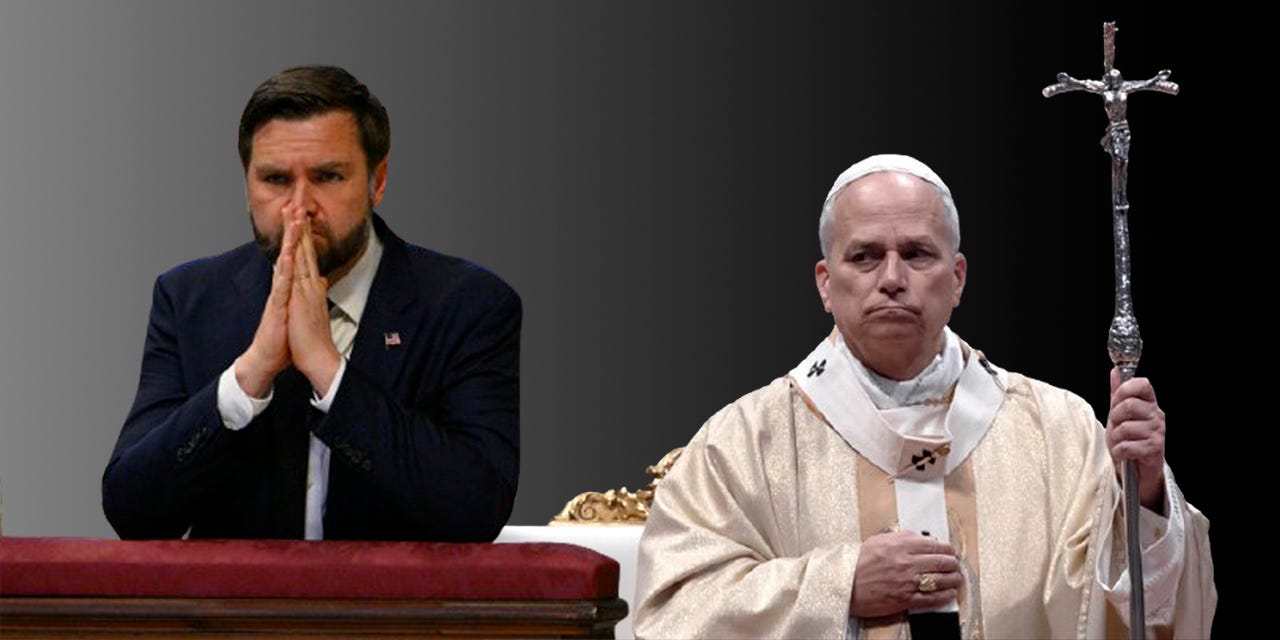
Why are supporters of President Trump’s war with Iran seeking the sanction of medieval Catholic theology and bickering with the pope?
Vice President Vance, House Speaker Mike Johnson and sundry other commentators have now invoked “just war theory” to defend the president against Pope Leo XIV’s criticisms of the war.1 Their “gotcha” attempts seem to aim at catching the pope in an inconsistency. In reality they reflect the administration’s failure to justify what is truly a righteous war against Iran. Invoking the religious doctrine is a futile and defensive measure that will only undercut the war effort.
Since Trump launched this war, his rationale has shifted dramatically, from helping the protesters foster regime change and the “unconditional surrender” of the Islamic Republic to merely dismantling Iran’s nuclear and ballistic missile programs.2 But he’s failed to explain why any of these objectives justifies American blood and treasure.
What he should have stressed from the beginning is that Iran’s 47 years of aggression against American citizens, soldiers, and allies long ago gave America an absolute right of self-defense to eliminate the threat of the Iranian regime.
Contrary to conventional thinking, the Christian “just war theory” does not allow this justification.
Pacifism — the idea that war cannot be justified even in self-defense — has long been the core of the Christian approach to war. This is no “leftist” innovation by the pope. The Catholic Catechism invokes Jesus’s injunction to love your enemies, and the Sermon on the Mount’s beatitude “blessed are the peacemakers.”3 The pope’s sermons are laced with references to Jesus as the “King of Peace,” who told his disciples to put away their swords even to defend him, as he gave himself up to be crucified.4 Christianity’s pacificism comes straight out of its morality of humility and self-sacrifice.
It’s true that the Catechism also contains provisions about “just war.” But it’s noteworthy that the elements of “just war theory” were first proposed by St. Augustine centuries after Jesus. In fact, Augustine had no real “theory” to speak of, just scattered passages sometimes allowing for war, contradicting his earlier denunciations of it in City of God.5 By this time the Church had finally achieved political power and had to fight wars to maintain it. This modest permission represented a compromise between the Christian faith and reality.
But even as Augustine allowed for some war, he never wandered far from his deeply Christian roots. In one letter, he writes: “As to killing others in order to defend one’s own life, I do not approve of this, unless one happen to be a soldier or public functionary acting, not for himself, but in defense of others or of the city in which he resides.”6 This denies a right to actual self-defense, allowing only for self-sacrificial defense of others — the humble, self-sacrificial approach to war. Subsequent formalizations of the notion made this clear, dramatically limiting even a victim of aggression to fighting back only “proportionally” and only as a “last resort.”
Trump is not the first president to humbly defer to just war theory’s irrational restrictions. American foreign policy has done it for decades. It was just war theory that guided us toward fighting “nation-building” wars in Iraq and Afghanistan, in which we prioritized dropping humanitarian aid, not bombs. It demanded that our troops be hindered and endangered by self-sacrificial rules of engagement, tying their hands against dangerous enemies. The fact that we’ve waited half a century to respond to Iran’s many acts of aggression is because we have, indeed, treated war as a “last resort.”
Given this history, there’s no chance just war theory would support a war in which American citizens and soldiers watch in relative safety as Iranians are targeted in response to the threat their Islamist regime has long posed.
And it’s also pointless to debate the applicability of the doctrine to the Iran war. There are no facts that will settle the question of whether, under just war theory doctrine, a particular war is being fought in a “proportionate” manner, as “a last resort,” or with a “good intention.” Not when what counts as “too much” and “too soon” are evaluated against someone’s faith-infused idea of what is “good” to achieve. (Anyway, Vance and Johnson are out of their depth in a debate with Pope Leo XIV about the relevance of Christian humility to its views on war — Leo wrote his dissertation on Augustine’s views of political authority.7)
Politicians’ last ditch eagerness to gain the sanction of religion will only undercut the war effort. One report suggests that the White House actually actively lobbied Vatican diplomats to join the campaign for the war.8 This betrayed a deep defensiveness and lack of independent moral clarity. If the president needs to secure the blessing of the Roman pontiff, and dares not challenge his basic premises, what chance does he have to understand let alone defeat the even more fanatically religious ayatollahs?
Citizens of a free republic rightfully demand their government’s accountability for its decisions to go to war. Obviously, questions of life and death should not be left to anyone’s whim-driven discretion. President Trump has already failed to secure the approval of Congress for this war. He adds insult to injury when instead of giving reasons to a deliberative, elective body, his supporters instead express their faith to impress a foreign cleric.
A morally principled American commander in chief does not traffic in humble faith. He should stand proud for his nation’s right to self-defense on the fully secular moral grounds of protecting its citizens’ individual rights to life and liberty.
“JD Vance Makes Address at Turning Point USA Rally,” Fox News YouTube channel, April 14, 2026; “Speaker Mike Johnson ‘Taken Aback’ by Pope Leo’s Comments Criticizing Iran War,” The Hill YouTube Channel, April 15, 2026; J. Budziszewski, “Is the War in Iran Just?,” Catholic World Report, April 14, 2026; Gerald Murray, “The Catholic Case for War with Iran, Free Press, April 15, 2026.
Franco Ordoñez, “How Trump’s Iran War Objectives Have Shifted Over Time,” NPR.org, March 25, 2026.
“Safeguarding Peace,” Catechism of the Catholic Church, Vatican.va..
Pope Leo XIV, “Palm Sunday: Passion of the Lord – Commemoration of the Lord’s Entrance into Jerusalem and Holy Mass,” Vatican.va, March 29, 202.
Phillip Wynn, “The Modern Construction of an Augustinian Just War,” in Augustine on War and Military Service (Minneapolis, MN: Fortress Press, 2013), 9–33; for samples of the scattered passages, see: Matthew Phillips, “Augustine on Just War,” Historia et Memoria blog, February 8, 2017.
St. Augustine of Hippo, Letter 47, to Publicola, (A.D. 398). NewAdvent.org.
Justin McLellan, “Vance Questions the Pope on Just War Theory Hours after Leo Honored its Founder,” National Catholic Reporter Online, April 15, 2026.
Mattia Ferraresi, “Why the Vatican and the White House Are on the Outs,” Free Press, April 4, 2026.
Image credits: Vance: ANDREAS SOLARO / AFP / via Getty Images; The Pope: Maria Grazia Picciarella / SOPA Images / LightRocket / via Getty Images
 | A guest post by
|
Just war theory is unjust.
Great article!!