

Trump Didn’t Corrupt Antitrust: Arbitrary Enforcement Is Nothing New
Contrary to Donald Trump’s critics calling to “depoliticize” antitrust enforcement, arbitrary antitrust laws have never been objectively enforced

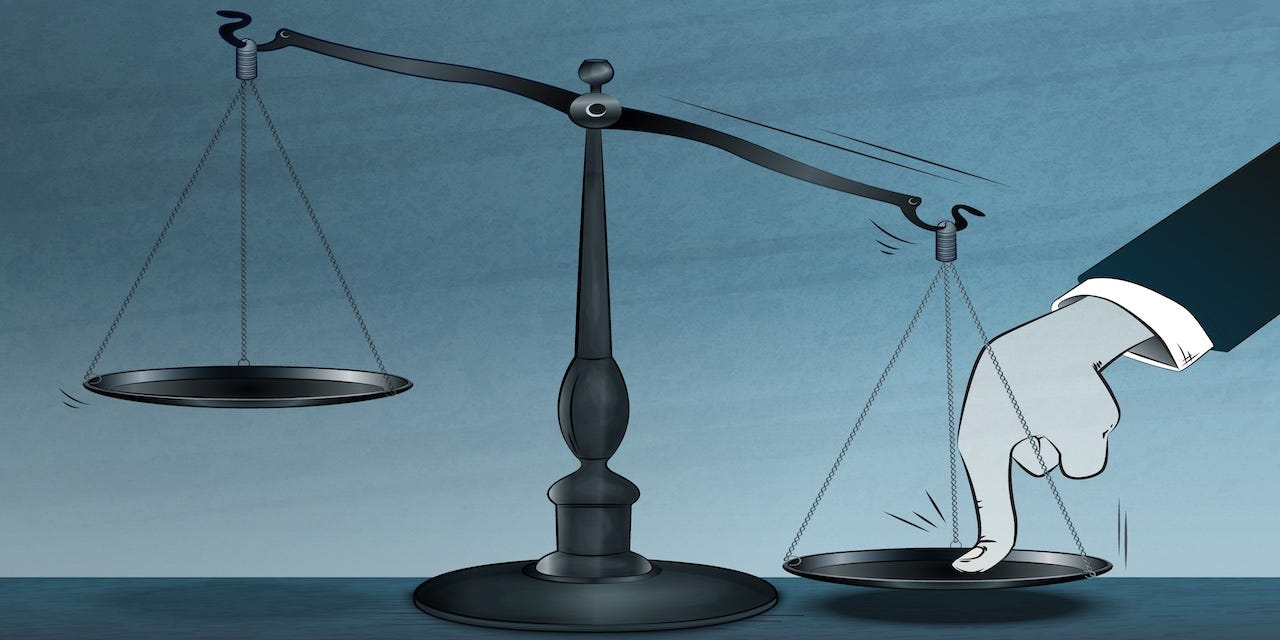
Have political connections to Donald Trump’s second administration become a get-out-of-antitrust-jail card?
In June 2025, the Department of Justice, following an alleged “boozy backroom” meeting between officials and lobbyists, settled its attempt to block the Hewlett Packard Enterprise (HPE)–Juniper Networks merger.1 Democratic senators, Republican appointees fired after decrying the settlement, and antitrust purists all protested that antitrust had become “politicized” because corruption and personal favoritism had replaced legal procedure.2, 3, 4, 5 But that was just the beginning.
Less than a month after Paramount agreed to pay Trump a $16 million lawsuit settlement, the Trump administration green-lit the Skydance–Paramount merger.6 Skydance’s CEO is the son of Larry Ellison, a close personal ally of the president.
Shortly after, the family connection seemed to pay off even more. Netflix abandoned its pursuit of Warner Bros. Discovery (WBD) in the face of massive regulatory hurdles. The freshly baked Paramount–Skydance snatched WBD, expecting a smooth sail through DOJ offices in exchange for “sweeping changes” at Trump-critical CNN.7, 8, 9, 10
Finally, the DOJ and Live Nation Entertainment struck a surprise settlement agreement, stunning the judge who had just kicked off the trial.11 It followed a White House meeting prompted by Donald Trump’s friend and former Live Nation board member Ariel Emanual. Trump obliged, calling around to ask, “What’s the holdup”?12
The administration’s antitrust enforcement exhibits the consequences of leaving vast, arbitrary power in executive hands. Antitrust scrutiny is often a matter of life and death for a business. While politically favored firms coast through reviews, others face the full wrath of regulators.
But the critics are misleading the public about the alternative to Trump’s use of antitrust power. In their letter to the judge, Democratic senators argue that the HPE–Juniper deal should be reviewed based on merit and public interest, not political favors and influence peddling.13 Many states’ attorney general refused to sign the settlement and pushed the Live Nation trial to its conclusion, boasting about taking on the role the corrupt federal government agency abdicated.14 The same coalition also promised a “vigorous review” of the Paramount–WBD deal.15
All of them presume that there could be non-arbitrary, legally proper antitrust enforcement. But there never has been such a thing. Trump’s use of antitrust to make businesses fall in line is just the most recent overt instance of a long history of arbitrary enforcement driven by favoritism. Antitrust has been subject to political whim from the outset.
The Long History of Presidential Favoritism in Antitrust
The Sherman Antitrust Act itself, the bedrock of the U.S. antitrust law, was born of political favoritism. Senator John Sherman sought Republican votes from small local manufacturers who wanted protection from competition with larger, more productive national corporations. A promise to control trusts also helped Republicans sway Democrats away from opposing another form of controlling trade Republicans preferred — tariffs.16 With the Sherman Act on the books, business survival came to depend on the regulators’ and president’s favor rather than productivity.
The famous “trustbuster,” Teddy Roosevelt, used political power to target what he called “bad trusts” (associated with the publicly reviled and uncooperative J. D. Rockefeller), while sparing the “good trusts” (linked to the more supportive House of Morgan).17
The other Roosevelt, FDR, similarly manipulated enforcement. He basically suspended antitrust during the early New Deal to secure corporate cooperation with price controls.18 But when he needed a scapegoat for failing New Deal policies, FDR launched a rhetorical war against business concentration.19 His appointee to lead Justice Department’s Antitrust Division, Thurman Arnold, would preside over the most aggressive period of antitrust enforcement to date (even though that wasn’t FDR’s intention).20 Soon though, Arnold was pushed out by the administration that needed big business’s support in the war effort.21 Thus, business experienced periods of lax, extremely aggressive, and again lax antitrust enforcement, morphing with the changing goals and rhetoric of FDR’s administration.
The pattern of brazen influence-peddling continued with both Democrats and Republicans.
President Johnson “threatened to block a merger involving a leading Houston bank unless the head of the bank helped secure the endorsement of the leading Houston newspaper for Johnson’s 1964 campaign.”22 Meanwhile, favorable rulings by the Federal Communications Commission allowed LBJ’s wife, Lady Bird Johnson, to maintain a TV station monopoly in Austin, Texas.23 No antitrust enforcer looked her way, thanks to Johnson’s political clout.
In 1969, President Nixon ordered his deputy attorney general to stop interfering with the International Telephone & Telegraph’s purchase of Hartford Fire insurance Company (the largest merger in America at the time) because ITT’s CEO was a friend, an ally, and a contributor. These campaign contributions to influence antitrust merger decisions became part of the Watergate scandal.24
Just weeks after Obama’s reelection, his appointees dropped an investigation into Google that could have turned into the biggest antitrust case since Microsoft’s. Unsurprisingly, some former Google executives, including CEO Eric Schmidt, were crucial assets in Obama’s 2012 campaign.25
The tables turned against Google when the first Trump administration, now criticized for not enforcing antitrust, pushed a case against Google right before the 2020 elections to make Trump appear tough on Big Tech.26
Throughout their 135-year history, U.S. antitrust laws always followed the presidential whim of the moment. President Trump’s blatant use of antitrust during his second term to reward his allies and punish dissenters is raising more eyebrows just because it’s more brazen. Sherman shrouded his favoritism towards small manufacturers under the language of promoting “competition.” Trump simply doesn’t care to obscure his motives, such as wanting a change in CNN’s content and leadership.27
Delinking the power that antitrust controls give the government over business from presidential whim would make antitrust enforcement somewhat less arbitrary. But purging such corruption from the halls of the DOJ and the White House would not and could not make it objective.
Objective Enforcement in the Courts?
When an administration threatens to prevent a business merger, why don’t the companies say to the government: “See you in court”? Litigation is expensive, of course, but companies like Netflix can afford it. If the executive branch makes antitrust enforcement decisions for nefarious reasons, the need to convince a judge that it is actually following the law should limit its ability to do so with impunity.
But there is a reason companies are reluctant to go to court. No matter what the facts are about its business operations, a company and its expert lawyers cannot determine if they have a winning case. This is not only because the Supreme Court over time only increased the uncertainty that businessmen face in “predicting in any particular case what courts will find to be legal and illegal under the Sherman Act,” but because the antitrust “laws” themselves are neither clear nor well-defined.28 Companies facing roadblocks or massive fines or break-ups cannot know how the judge should rule in their case any more than they can know which cocktail will sway an administration official’s arbitrary power in their favor.
Consider the central principle of antitrust: The Sherman Act declares illegal every contract, combination, or conspiracy that is deemed to be “in restraint of trade or commerce.”29, 30 But any contract is a “restraint of trade” of sorts by its nature: If I sign a contract that says I will purchase spare parts from you for five years in exchange for consistent delivery, a discount, and maintenance and repair services, we thereby both “restrain trade” for five years with anyone else who would like to fix my machines or sell me parts. Yet no businesses can plan long-term without such “restraints.”31
For example, Schwinn & Co. found that the only way it could compete in the bicycle market against mass merchandisers like Sears and Montgomery Ward was to assign exclusive territories to independent bicycle wholesalers. A condition of this contract was that wholesalers could not sell to anyone other than franchised retailers, and retailers could not sell outside their assigned territory.32
But in 1967 the court ruled Schwinn’s contracts illegal “restraints of trade.” Had Schwinn just vertically integrated with retailers by directly owning them (as it started doing after the ruling), it would have avoided antitrust scrutiny. But no matter how many lawyers it consulted in advance, Schwinn could not have known that vertical integration wouldn’t be condemned as “restraint of trade,” but contracts with independent retailers would. Other companies have been severely punished for vertical integration as allegedly a form of seeking monopoly power. Moreover, about a decade later, the courts reversed course, ruling that territorial restraints were actually acceptable.33 No one, then or now, can say which court’s “interpretation” of antitrust law — territorial restraints are or are not illegal — is correct.
Now take the rules prohibiting “attempts to monopolize.” After a century of debate, judges still have no way to distinguish between “willful acquisition or maintenance of [monopoly] power” and “growth or development as a consequence of a superior product, business acumen, or historic accident,” as the Federal Trade Commission says courts should do.34, 35
In the famous Alcoa (Aluminum Company of America) case, Judge Learned Hand tried but failed to make this distinction meaningful. In his 1945 opinion, Hand first reiterated the arguments that “a single producer may be the survivor out of a group of active competitors” and should not be punished after winning “merely by virtue of his superior skill, foresight and industry.”36 But then he condemned Alcoa for precisely these traits, writing that “nothing compelled” the company to willfully “embrace each new opportunity as it opened [Alcoa’s foresight], and to face every newcomer with new capacity already geared into a great organization [Alcoa’s industry], having the advantage of experience, trade connections and the elite of personnel [Alcoa’s skill].”37
Hand failed because on a free market there is no such distinction to be made.
A company willfully pursues market power by building superior products and engaging in excellent, future-looking, long-term strategy. Yet to avoid a charge of “willful acquisition” of power and to instead grow “naturally” in the eyes of antitrust law, the company would have to not embrace new opportunities, not build a team of top talent, not anticipate changes in the market, and not invest in future production. But then no growth would exist. Businesses do not grow automatically, as though preprogrammed by nature, and they don’t grow accidentally. They grow through conscious, ambitious plans to make a profit by besting competitors. Both “natural growth” and “willful acquisition,” if they refer to anything, refer to the same thing.
But because antitrust law pretends that they are distinguishable, any business can be charged with an antitrust violation simply for pursuing success, whenever a regulator or a judge feels like it. All that is needed is just to place the growth and success of a company like Alcoa into the arbitrary category of “willful acquisition of power” rather than the arbitrary category of “natural growth.” Alcoa and the like have better chances to defend themselves in the backroom of a cocktail bar than in court.
Then there is the Clayton Act that prohibits exclusive dealing where it would “substantially lessen competition.”38
Consider the HPE–Juniper merger. On one interpretation, a merger between an enterprise IT provider (HPE) and a networking specialist (Juniper) increases competition by creating an integrated entity capable of tackling Cisco, the current WLAN market leader. But under another interpretation, the deal reduces competitive pressures in the enterprise wireless LAN sector by reducing the number of companies in that market.
How would one adjudicate between these perspectives? Allowing the merger because it enhances competition or preventing it for “substantially” inhibiting competition are both compatible with antitrust law. A judge might as well flip a coin. Which means that there are no objective criteria by which the companies could know that their envisioned conduct, their prospective merger, is lawful or unlawful.
Similarly, some argued that Netflix’s attempted purchase of WBD would “kill the entire movie theater business” through consolidation.39 Others countered that Netflix is competing not only with Disney and Amazon, but with YouTube, TikTok, Instagram, Snapchat, Twitch, and video games: “Combining Netflix and Warner Bros. doesn’t reduce competition. It strengthens traditional entertainment against far larger digital rivals and preserves a major studio.”40 Both verdicts — that the purchase restrains trade or enhances it — are compatible with antitrust laws.
Under antitrust law, businesses cannot know in advance whether their most routine business decisions are legal or illegal. This means that they are not operating under the rule of law. And this is why they are reluctant to go to court. It’s akin to a dice roll.
The history of antitrust enforcement shows that attempting to navigate antitrust laws in the courts is in principle no different from navigating executive favoritism through personal relationships with politicians and informal backroom deals. Only it’s a judge one needs to “convince” instead of someone politically connected enough over a cocktail. Because antitrust law itself is arbitrary, even the best intentions of the judiciary can’t rectify this problem.41
There Is No Better Alternative to “Politicized” Antitrust
Arbitrary enforcement is not an unfortunate bug of the antitrust system. It is a feature that resulted from trustbusters’ realization that writing antitrust laws to be as definite as laws against traffic violations or theft, which prohibit exact and specific actions that are knowable in advance by the citizenry, wasn’t feasible.
Trustbusters could have banned specific activities like exclusive sales agreements, preferential contracts, or price discrimination (such as selling the same item at different prices in different places).42 But such clarity would effectively outlaw business itself, a result beyond the goals of even the most aggressive anti-big business pundits. Louis Brandeis, a leading progressive legal scholar and soon-to-be Supreme Court Justice, for example, believed concentration was inherently evil. But even Brandeis had to disgruntledly acknowledge and help persuade President Woodrow Wilson that one cannot enumerate, define, and outlaw “unfair” practices that allow business to grow big without simultaneously criminalizing ordinary contracts that every small business engages in and depends on.43, 44
So instead, they left us a system that grants arbitrary power to the executive and judiciary to decide when they happen to like or dislike a business’s practices. As a consequence, an uninterrupted string of favoritism and whim-based decisions plague successful American businesses to this day.
Donald Trump’s use of antitrust to reward his favorites and punish critics is brazen.45 But contrary to the wishful thinking of his critics, judicial process dressed in the veneer of objective application of vague statute cannot resolve the problem. As we’ve seen, the difference is illusory.
Calling for “depoliticization” of antitrust as if that is an obvious solution is a farce. We should castigate the corruption of backroom deals. But it is mere posturing unless we grapple with the fact that there is no such thing as the objective application of arbitrary power.
Sohrab Ahmari, “The Antitrust War Inside MAGA. Powerful Lobbyists Are Battling Populist Reformers,” UnHerd, 30 July 2025.
Judiciary Democrats Rebuke DOJ’s Corrupt Settlement of HPE–Juniper Merger and Request Comprehensive Review by the Court | U.S. House Judiciary Committee Democrats, 9 Sep 2025.
David Dayen, “DOJ Insider Blows the Whistle on Pay-to-Play Antitrust Corruption,” American Prospect, 19 Aug 2025.
American Economic Liberties Project, “Economic Liberties Calls on Congress to Investigate AG Pam Bondi’s Role in HPE–Juniper Settlement,” 24 July 2025.
Jamie Raskin and Jerrold Nadler, letter to Department of Justice re: Tunney Act HPE–Juniper Comments, 8 Sep 2025, available at House Judiciary Committee Democrats website.
Joe Flint, “FCC Approves Paramount’s $8 Billion Merger with Skydance,” Wall Street Journal, 24 July 2025.
Corbin Bolies, “David Ellison Promised White House Sweeping Changes at CNN | Report,” TheWrap, 9 Dec 2025.
Peter Kafka, “It’s Easy to Understand Why Netflix Walked Away from WBD,” Business Insider, 26 Feb 2026.
Jessica Toonkel and Lauren Thomas, “Gulf Funds Agree to Back Paramount’s $81 Billion Takeover of Warner,” Wall Street Journal, 6 Apr 2026.
Robertas Bakula, “How Antitrust Probe into Netflix and WBD Merger Killed Their Intellectual Freedom,” Orange County Register, 15 Apr 2026.
Kara Scannell, “Judge Scolds Live Nation and Justice Department for Secret Settlement Talks,”CNN, 10 Mar 2026.
Dana Mattioli, Rebecca Ballhaus, and Josh Dawsey, “The Threats and Bare-Knuckle Tactics of MAGA’s Top Antitrust Fixer,” Wall Street Journal, 20 Mar 2026.
Senator Elizabeth Warren, letter to Judge Casey Pitts re: HPE–Juniper Merger and Tunney Act, available at Warren Senate website.
David Dayen, “States Substitute for Corrupt Feds on Antitrust,” American Prospect, 17 Mar 2026.
Coral Murphy Marcos, “‘Not a Done Deal’: California Vows ‘Vigorous’ Review of Paramount–Warner Bros. Takeover,” The Guardian, 27 Feb 2026.
Richard N. Langlois, The Corporation in the 21st Century: A History (Cambridge: Cambridge University Press, 2023), 40–42.
George W. Perkins, a partner at J. P. Morgan, who was closely involved in creation of International Harvester and chaired the finance committee of U.S. Steel, was “a political and financial supporter of Roosevelt.” Perkins’s and the House of Morgan’s cooperation with Roosevelt’s administration helped them end up on the good side of the president. Standard Oil, however, was associated with John D. Rockefeller who “the public were already predisposed” against, making it an easy political target (see Richard N. Langlois, The Corporation in the 21st Century: A History (Cambridge: Cambridge University Press, 2023, 79). It didn’t help Rockefeller that he was reluctant to cooperate with the administration and “attempted to block the creation of the Bureau [of Corporations]”; see William Murphey (2013), “Theodore Roosevelt and the Bureau of Corporation: Executive-Corporate Cooperation and the Advancement of the Regulatory State,” American Nineteenth Century History, DOI: 10. 1080/ 14664658.2013.774983.
The National Industry Recovery Act of 1933 included provisions that effectively established legalized business cartels, conducive to FDR’s plan to raise the price- and wage-level throughout the economy which his administration falsely believed would boost purchasing power (see George Selgin, False Dawn, University of Chicago Press, 2025,114–15).
George Selgin, False Dawn, University of Chicago Press, 2025,117.
Ibid., 116–18.
Richard N. Langlois, The Corporation in the 21st Century: A History. Cambridge: Cambridge University Press, 2023, 18, 289–90.
Spencer Weber Waller and Jacob E. Morse, “The Political Misuse of Antitrust: Doing the Right Thing for the Wrong Reason,” Competition Policy International, July 2020.
Josh Blackman, “President Lyndon B. Johnson’s TV Station and the ‘Blind Trust,’” Reason.com, 1 Jan 2025.
Ibid.
Andrew Orlowski, “How Barack Obama Created the Google Monster,” UnHerd, 12 Sep 2023.
Eric Lutz, “Is Bill Barr’s Rushed Case Against Google a Political Hit Job?,” Vanity Fair, 4 Sep 2020.
Brian Stelter, “Trump Enters Warner Bros. Fight, Says It’s ‘Imperative That CNN Be Sold’,” CNN Business, 10 Dec 2025.
Mathew G. Sipe (2022), “The Sherman Act and Avoiding Void-For-Vagueness,” Florida State University Law Review 45:3, 722.
Sherman Antitrust Act, 15 U.S.C. §§ 1–7 (1890) (as amended through P.L. 108-237, enacted June 22, 2004).
Ironically, antitrust actions against contractual coordination pushed many corporations to integrate into single legal entities where coordination happened through command and control rather than contract (as against, for example, holding companies that were a result of a set of contractual arrangements and mutual stock ownership). Thus, antitrust — a law primarily concerned with big business — encouraged instead of preventing integration within firms. Du Pont, for example, anticipated antitrust litigation and started the move away from contractual arrangements of a holding company to become a large functionally organized, integrated enterprise, a process that was well underway when DOJ filed a suit against them in 1907 (see Richard N. Langlois, The Corporation in the 21st Century: A History (Cambridge: Cambridge University Press, 2023), 68–69).
It would be more accurate to think of such contracts as “enablers of trade,” not “restraints” in the first place. Their primary function is to set conditions under which long-term planning of production and trade is possible and beneficial. Without such contacts, businesses would be groping in the dark and relying on hope that everything turns out ok. Elimination of such contracts would make business more akin to gambling.
United States v. Arnold, Schwinn & Co., 388 U.S. 365 (1967).
In Continental T.V., Inc. v. GTE Sylvania, Inc., the Supreme Court “overruled its holding in United States v. Arnold, Schwinn & Co.” by abandoning the per se analysis that deemed territorial restraints illegal by default and adopting the rule of reason approach that required weighting pro- and anti-competitive effects of such restraints case by case (see Agnes Pek Dover, “The Real Thing: Special Antitrust Treatment for the Soft Drink Industry,” Catholic University Law Review, vol. 30, issue 1, 1980).
Federal Trade Commission, “Monopolization Defined”; quoting from United States v. Grinnell Corp., 384 U.S. 563 (1966).
Karen L. Grimm, “General Standards for Exclusionary Conduct,” Federal Trade Commission, Working Paper, 3 Nov 2008.
United States v. Aluminum Co. of America, 148 F.2d 416 (2d Cir. 1945).
Ibid.
Clayton Act, 15 U.S.C. 12 (1914) (as amended through P.L. 108–237, enacted June 22, 2004).
Matt Stoller, “Netflix Is Trying to Buy Warner Bros. Discovery. That Would Be a Disaster for America,” BIG by Matt Stoller (Substack), 5 Dec 2025.
Josh Harlan, “The Netflix–Warner Bros. Deal Could Revive Hollywood,” Wall Street Journal, 8 Dec 2025.
The only way to rectify the problem of arbitrariness in antitrust laws is to declare them unconstitutional. For a discussion of how a void-for-vagueness doctrine could apply and how the Sherman Act could be altered accordingly, see, for example, Mathew G. Sipe (2022), “The Sherman Act and Avoiding Void-For-Vagueness,” Florida State University Law Review, 45:3.
In 1914, William H.S. Stevens, future assistant chief economist of the Federal Trade Commission (FTC) proposed eleven forms of such “unfair” competition practices: (1) Local price-cutting. (2) Operation of bogus “independent” concerns. (3) Maintenance of “fighting ships” and “fighting brands.” (4) Lease, sale, purchase or use of certain articles as a condition of the lease, sale, purchase or use of other required articles. (5) Exclusive sales and purchase arrangements. (6) Rebates and preferential contracts. (7) Acquisition of exclusive or dominant control of machinery or goods used in the manufacturing process. (8) Manipulation [probably meaning attempting to corner a market]. (9) Blacklists, boycotts, white-lists, etc. (10) Espionage and use of detectives. (11) Coercion, threats and intimidation (see Footnote 188 in Werden, Gregory J., “Unfair Methods of Competition Under Section 5 of the Federal Trade Commission Act. What Is the Intelligible Principle?,” Mercatus Center, 10 May 2023).
Brandeis describes the difficulty of clearly defining “unfair” methods of competition in his dissenting opinion in FTC v. Gratz: “Experience with existing laws had taught that definition, being necessarily rigid, would prove embarrassing and, if rigorously applied, might involve great hardship. Methods of competition which would be unfair in one industry under certain circumstances might, when adopted in another industry, or even in the same industry under different circumstances, be entirely unobjectionable. Furthermore, an enumeration, however comprehensive, of existing methods of unfair competition must necessarily soon prove incomplete, as, with new conditions constantly, arising novel unfair methods would be devised and developed.” (Louis D. Brandeis, dissent in FTC v. Gratz, 253 U.S. 421, 436–37 (1920), available at Justia U.S. Supreme Court Center).
Willam Kolasky describes the meeting between President Wilson, Brandeis, George Rublee (a lawyer involved in drafting the FTC act), Congressman Raymond Stevens, and New Hampshire Senator Henry Hollis, with Rublee trying to convince the president about the need for the Federal Trade Commission that would determine if and when a violation of the Clayton Act has appeared: “The meeting with Wilson took place on the South Lawn of the White House on a warm late May afternoon and lasted well beyond its allotted half-hour. Rublee and Brandeis were joined by Congressman Stevens and New Hampshire Senator Henry Hollis. After an opening statement by Stevens, Rublee outlined his proposal to Wilson. He argued that the Clayton bill was flawed because “it was impossible to define these unfair practices” in a way acceptable to the courts. It would be better, he argued, simply to prohibit unfair methods of competition and create a strong trade commission that would determine whether a violation had occurred in order to “nip restraint of trade in the bud.” As Rublee later recalled, he sensed he was “making an impression on the President,” who “listened very attentively and asked some questions.” Rublee added that when he had finished, Brandeis, to Rublee’s “great surprise . . . entered the fray with great enthusiasm and backed me up strongly.” By the end of the meeting, Rublee thought “it was clear to all of us that the President had accepted the idea.” As they left the White House, Brandeis told Rublee it was “the most remarkable interview that I have ever been present at.” (Willam Kolasky, “The Origins of the FTC: Concentration, Cooperation, Control, and Competition,” Antitrust, vol. 26, no. 1 (2011):108).
Josh Dawsey, Dana Mattioli, Rebecca Ballhaus, and Jessica Toonkel, “Inside Trump’s Takeover of the American Regulatory Machine,” Wall Street Journal, 2 Jun, 2026.
Image credit: Cemile Bingol / DigitalVision Vectors / via Getty Images
 | A guest post by
|
Well researched and written. Good piece!