

When Ayn Rand Took the Stage: Highlights from Her Public Speaking Career
Over five decades before live audiences, Rand conveyed the power of philosophy in shaping the world

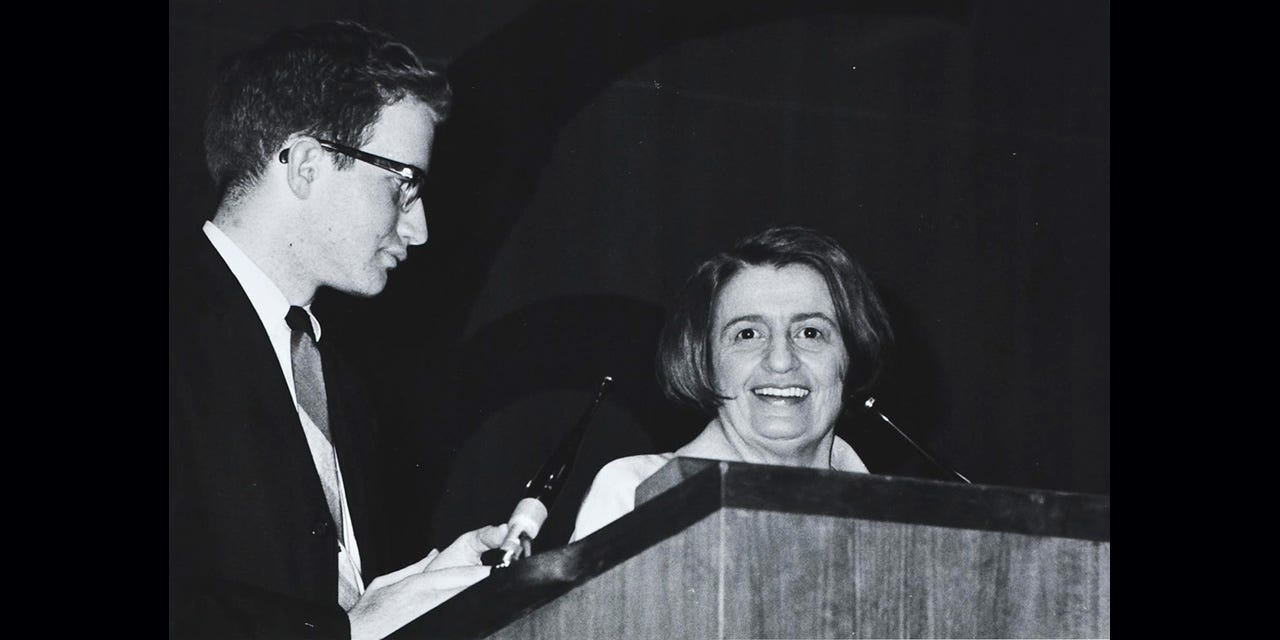
Ayn Rand is well known to millions of fans as the author of The Fountainhead and Atlas Shrugged, but she also built an enduring legacy as a public intellectual, not only through the written word but also from behind the lectern.
In biographical interviews, now housed in the Ayn Rand Archives, Rand once admitted, “I don’t particularly enjoy speaking, neither the process, nor the question periods.”1 Yet, she recognized the value of reaching an audience through the spoken word, whether on radio, television, or in a packed auditorium before a live audience.
From her earliest public appearances in the 1930s to her nationally broadcast interviews in the 1960s to her addresses at the Ford Hall Forum and at West Point, Rand used these venues as a platform for advancing her radical new philosophy.
A Novelist and a Public Intellectual
In May 1936, a month after the publication of her first novel, We the Living, Rand was referred to as “probably New York’s busiest lecturer” by the New York World-Telegram, citing her presentations at various clubs.2 In one of these talks, titled “Whitewashed Russia,” Rand promoted her new novel while challenging the pro-Soviet sympathies of Western intellectuals.3 It is among the earliest documented examples of Rand’s public speaking career.
During this period, Rand witnessed the growing popularity of communism in intellectual circles, the very thing she had fled in Soviet Russia. She had seen firsthand the impact of collectivism on the lives of individuals, and watched with horror as those same ideas manifested in America, particularly under the policies of Roosevelt’s New Deal.
To counter this growing trend, Rand devoted three months, unpaid, to work for the 1940 presidential campaign of Republican candidate Wendell Willkie. She prepared “intellectual ammunition” for Republican writers and speakers, and also answered questions before live audiences. Decades later, Rand reportedly said that she enjoyed those experiences immensely, particularly clarifying complex ideas and communicating with antagonistic audiences.4
Even before Rand achieved significant recognition as a bestselling author and public intellectual, she sought opportunities to confront prevailing cultural ideas directly, a trend that would continue, with increasing scope, for the rest of her life.
Atlas Shrugged as a Turning Point
During the years she was writing Atlas Shrugged (1945 to 1957), Rand’s public speaking activity was minimal, but soon after its publication this would change dramatically.5
When the book was published in 1957, Rand believed she had fulfilled her purpose as a novelist: presenting “her ideal man” and “ideal view of existence,” as well as a new, rational code of morality.6 She expected the novel to spark serious engagement, even if in the form of strong, intelligent opposition.
Instead, she was “enormously shocked by the state of the culture and by the attacks on Atlas, not by the attacks themselves, but by the fact that there was nobody to oppose them.”7 What she encountered instead was “abysmal, stupid hooliganism,” smearing, self-contradictory reviews instead of real, intellectual engagement.8
Because the intellectual establishment refused to grapple with her ideas, and because no other cultural voices were defending them, Rand saw a need to take her case directly to active-minded members of the general public.
She also came to see, through ongoing conversations with her students, particularly Leonard Peikoff, that some elements of her philosophy were more radical than she had initially realized.9 This deepened her commitment to elaborating on her ideas in multiple formats, whether in essays and books or in lectures, interviews, and Q&A sessions.
Rand was acutely aware of her own limitations as a speaker, both because of her preference for the written word and knowing that her Russian accent would be a barrier for effective communication.10 But by 1961, she stated that she was eager to face the challenge of speaking before live audiences:
Right now, I am beginning to feel not only that I want to do it, but actual enthusiasm and impatience. I’m beginning to be very nervous about all my speaking engagements, because it’s time to get to work. And I have not felt that since I finished Atlas. So that is a very good sign. It reminds me of the early days of approaching The Fountainhead or Atlas, that is, the feeling of I am taking on a big assignment.11
From 1959 to 1961, Rand appeared in a series of four television interviews with Mike Wallace. Starting in 1960, she engaged in more than sixty broadcasts on WBAI radio in New York City and gave talks at major universities. One such talk, “The Objectivist Ethics,” was delivered at a 1961 symposium titled “Ethics in Our Time” at the University of Wisconsin, later republished as the first chapter in The Virtue of Selfishness. In this same period, she spoke at Yale, M.I.T., and Lewis & Clark College (where she was awarded an honorary Doctor of Humane Letters degree and delivered “The Goal of My Writing”).12
Her influence expanded further into mainstream culture with three appearances on The Tonight Show with Johnny Carson in 1967.13 In an era when late-night television reached millions of Americans, Rand used Carson’s platform to present her ideas to a mass audience. Over the course of three interviews, she discussed topics ranging from happiness and creativity to the Vietnam War, the military draft, and the moral foundations of capitalism. The audience response was extraordinary. Thousands of letters poured into NBC and into Rand’s office, marking one of the strongest public reactions to her television appearances.14
The Ford Hall Forum and Rand’s Later Speaking Career
Rand’s ultimate goal was to reach active minds. Of all her speaking platforms, none proved more enduring or important than the Ford Hall Forum in Boston.15 Starting in 1961, Rand gave nineteen lectures at the Forum, each one a major cultural event within the growing Objectivist movement.16 The Forum, founded in 1908, had a long-standing reputation for open inquiry. Rand praised it as a rare institution that treated ideas with the seriousness they deserved.
Rand valued the presence of the Forum’s president, Judge Reuben Lurie, who served as moderator for sixteen of Rand’s nineteen talks at the Forum. His skill in managing audience questions and his respectful demeanor created an atmosphere in which Rand could reach the kind of minds that she had always sought.
Lurie commented on the uniqueness of Rand’s events at the Forum, noting that she attracted crowds of people that had traveled from all over the country.17 Frances Smith (who worked for the Ford Hall Forum for forty years, serving as executive director, president, and chairman of the board) stated that Rand’s talks would fill the thirteen hundred-seat auditorium, and that an overflow crowd of about five hundred people would listen (through a loudspeaker) to Rand’s talks in an adjacent building.18 Beyond the walls of Jordan Hall and later Alumni Hall, Rand’s talks were broadcast on Boston’s WGBH radio, then re-aired in other cities (such as on WBAI and Columbia’s WKCR radio).
Rand’s career as a speaker culminated in several landmark addresses. In 1974, she delivered “Philosophy: Who Needs It” to cadets at West Point, a speech that later became the title essay of her final book of the same name, published posthumously in 1982.19 In that lecture, she made the case not for her particular philosophy but for the importance of philosophy as such, and that the subject is unavoidable for every living person. Leonard Peikoff reported that the crowd of twelve hundred greeted Rand with a standing ovation.20
Her last public lecture, “The Sanction of the Victims,” was delivered in November 1981 at the National Conference on Monetary Reform in New Orleans, in which she urged an audience of investors and businessmen to stop supporting ideas and institutions that furthered their own destruction: “millions of dollars are being donated to universities by big business enterprises every year . . . . some of [the] worst anti-business, anti-capitalism propaganda has been financed by businessmen in such projects.”
She was scheduled to deliver the lecture again at the Ford Hall Forum in the spring of 1982, but she died in March of that year. In her place, Leonard Peikoff, Rand’s legal and intellectual heir, took the stage and read the speech to a packed hall in Boston. Peikoff would continue Rand’s tradition at the Forum over the next two decades, delivering a total of fifteen Ford Hall Forum talks between 1982 and 2003.
A Legacy at the Podium and On Air
Rand’s speaking engagements were ultimately part of a larger intellectual campaign: to reclaim the culture by offering a positive, rational alternative to modern intellectual trends.
These events often left a deep and lasting impression on those who attended, inspiring a generation of students, scholars, and professionals to carry her ideas forward. In the 1997 documentary Ayn Rand: A Sense of Life, several individuals who heard Rand speak recalled how her talks were received by those in attendance. Leonard Peikoff recalled that “she faced, at first, very antagonistic audiences. They booed her, they tried to out-yell her, but, of course, she was immutable. She was herself on the lecture platform, and I’ve seen audiences start booing and end up cheering.”21
Those who heard her speak often remarked on the intensity of her presence and her capacity to deal with questions directly and unflinchingly. Harry Binswanger, who first saw Rand speak at M.I.T. in 1962, remarked in Ayn Rand: A Sense of Life that “she had the ability to deal with anything that could come up from an audience. . . . We were just coming out of the ’50s . . . when no one would take a stand on anything. . . . But she was there making the most dramatic and passionate statements, saying everything was simple, absolute, clear cut.”22
The effect of this clarity was felt not just in the lecture hall but in the hours that followed. The late John Ridpath, an acquaintance of Ayn Rand from 1962 to 1982, and a professor of intellectual history and economics at York University, remembered post-lecture gatherings in Boston where Rand would entertain questions until dawn.23
Perhaps the best summation of why Rand engaged with the public in the way that she did came during her second television interview with Mike Wallace in 1960. After she gave a grim prognostication of the state of the world and the lack of men of great ability in today’s culture, Wallace commented that Rand must be “an awful pessimist.” Rand responded: “Oh, not at all. Ideas brought us here and ideas can take us out. I am the opposite of a pessimist. Why do you think I come out and defy 2,000 years or more of civilization? Because I know that if the right is on my side, if reason is on my side, I will win. The right ideas have always won.”24
Ayn Rand, Biographical Interview #18 by Barbara Branden and Nathaniel Branden, April 25, 1961, transcript p. 630 (Ayn Rand Archives).
New York World-Telegram, May 14, 1936, Ayn Rand Archives 074_07M_019. The article in the New York World-Telegram makes reference to Rand’s May 14 talk for the “Literature Committee of the American Woman’s Association,” her talk on May 18 for “Claudine MacDonald’s Woman Radio Review,” her talk on May 19 for the “Forum of International Affairs at the Town Hall Club,” and her talk on May 21 for “Miss Fraser’s Theater Club.”
“2,000,000 Snow-White Angels,” New York Evening Journal, May 20, 1936, Ayn Rand Archives, 059_01x_009.
Barbara Branden, “A Biographical Essay,” in Who Is Ayn Rand?, by Nathaniel Branden (New York: Random House, 1962), 199.
One notable exception included Rand’s testimony as a friendly witness before the House Un-American Activities Committee. For more on Rand’s HUAC testimony, see Robert Mayhew, Ayn Rand and Song of Russia: Communism and Anti-Communism in 1940s Hollywood (Lanham, MD: Scarecrow Press, 2005); Elan Journo, “Why Rand Was Right to Testify Against Hollywood Communism,” New Ideal, July 24, 2019, https://newideal.aynrand.org/why-rand-was-right-to-testify-against-hollywood-communism/; Audra Hilse, “Testifying for the Sake of Justice: Ayn Rand and the HUAC Hearings,” New Ideal, August 28, 2024, https://newideal.aynrand.org/testifying-for-the-sake-of-justice-ayn-rand-and-the-huac-hearings/.
Biographical Interview #17, April 19, 1961, 590.
Biographical Interview #18, 622.
As an example of the kinds of reviews Rand was likely referring to in this segment, Whittaker Chambers’s review of the novel in the National Review stated, “From almost any page of Atlas Shrugged, a voice can be heard, from painful necessity, commanding: ‘To a gas chamber — go!’.” Whittaker Chambers, “Big Sister Is Watching You,” National Review, December 28, 1957.
Biographical Interview #18, 623.
Leonard Peikoff, interview in Ayn Rand: A Sense of Life, directed by Michael Paxton (Los Angeles: Michael Paxton Productions, 1997).
Biographical Interview #18, 624.
Letter dated May 18, 1863, from Ayn Rand to John Howard (president, Lewis & Clark College), Ayn Rand Archives, 081_17x_031.
For more on Ayn Rand’s three appearances on The Tonight Show, see “Ayn Rand in America’s Living Rooms: The Tonight Show, 1967,” by Tom Bowden, New Ideal, June 6, 2022, https://newideal.aynrand.org/ayn-rand-in-americas-living-rooms-the-tonight-show-1967-2/.
Adrian Slifka, “Ayn Rand Pulls TV Mail,” Youngstown Vindicator, December 19, 1967, Ayn Rand Archives, 006_04A_002; note dated December 5, 1967, from Beatrice Fletcher to Ayn Rand, Ayn Rand Archives, 010_24x_006.
For more on Ayn Rand’s nineteen appearances at the Ford Hall Forum, see “Reaching Active Minds: Ayn Rand and the Ford Hall Forum,” by Tom Bowden, New Ideal, March 24, 2021, https://newideal.aynrand.org/reaching-active-minds-ayn-rand-and-the-ford-hall-forum/.
Because ten of Rand’s talks took place in the spring, and because the long lines outside the Forum became places of social interaction for Objectivists, Rand’s appearances at the Forum became unofficially known as “Objectivist Easter”; Susan Chira, “Followers of Ayn Rand Provide a Final Tribute,” New York Times, March 10, 1982.
Ayn Rand, “Egalitarianism and Inflation,” moderated by Reuben L. Lurie, October 20, 1974, audio recording, Ford Hall Forum records (MS.SC.0018), Boston Public Library, Archives & Special Collections.
Frances Smith, interview by Scott McConnell, June 4, 1999, in 100 Voices: An Oral History of Ayn Rand, ed. Scott McConnell (New York: New American Library, 2010), 223.
For more on Ayn Rand’s West Point lecture, see “Ayn Rand at West Point: ‘Philosophy: Who Needs It’” by Tom Bowden, New Ideal, March 6, 2024, https://newideal.aynrand.org/ayn-rand-at-west-point-philosophy-who-needs-it/; “Behind the Scenes: Ayn Rand’s West Point Lecture” by Shoshana Milgram, recorded lived on June 14, 2024, in Anaheim, California, as a part of OCON 2024, uploaded to YouTube on September 30, 2024,
Leonard Peikoff, “A Report,” Ayn Rand Letter 3, no. 10 (February 11, 1974).
Leonard Peikoff, interview in Ayn Rand: A Sense of Life, directed by Michael Paxton (Los Angeles: Michael Paxton Productions, 1997).
Harry Binswanger, interview in Ayn Rand: A Sense of Life.
John Ridpath, interview in Ayn Rand: A Sense of Life.
Ayn Rand, interview by Mike Wallace, The Mike Wallace Interview, recorded April 18, 1960, broadcast May 4, 1960, Syracuse University Libraries, Mike Wallace Papers, wallace_m_043.
 | A guest post by
|
Ayn Rand was a force of nature on the podium. I saw her on Valentine’s Day, 1967. Her topic for the evening was “Can You Measure Love?” Rand’s answer opened with a resounding, “You betcha!”
She then proceeded to tell the audience how. It was the experience of a lifetime.
I have never stopped learning from Ayn Rand’s work.
Crazy Nationalist B!tch