

A Wall of Separation between Church and State
Understanding This Principle’s Supporting Arguments and Far-Reaching Implications

Does the First Amendment separate church and state?
Thomas Jefferson thought so. In a letter written early in his presidency, Jefferson famously described the First Amendment to the US Constitution as “building a wall of separation between Church & State.” But Jefferson’s often-used metaphor of a wall is, by itself, insufficient to convey with precision the principle of church-state separation and the reasons in support of the principle. In the ensuing years, public debate has overly focused on the metaphor and become increasingly confused.
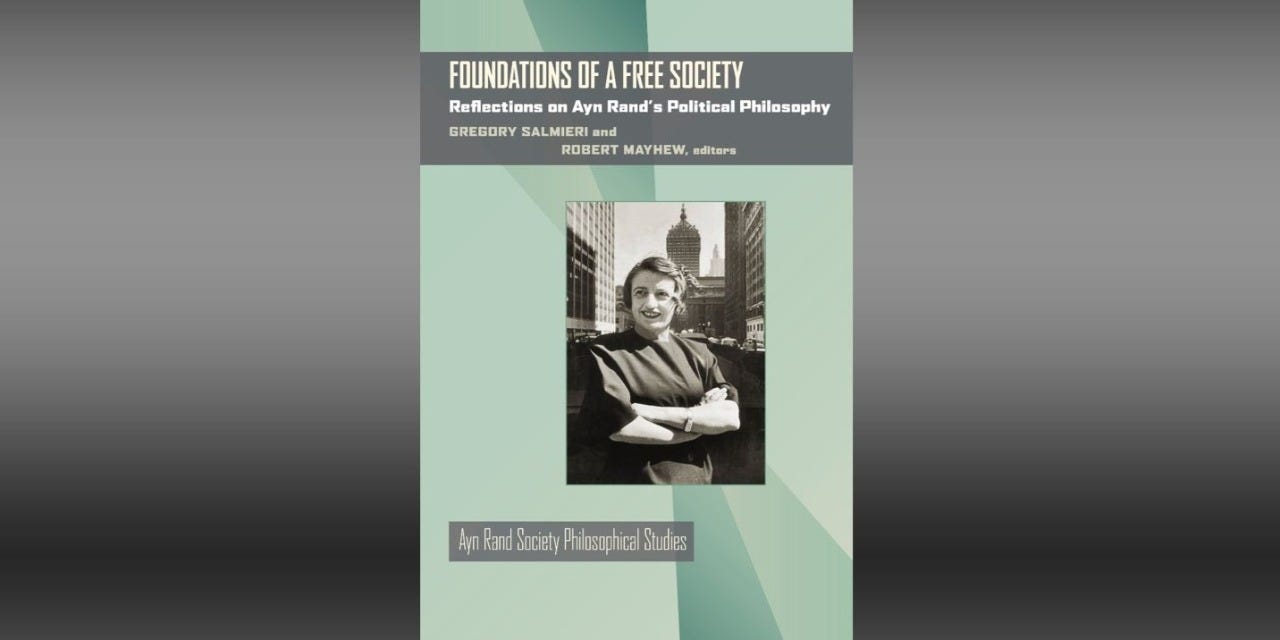
To resolve this confusion and clarify the vital principle at stake, Ayn Rand Institute philosopher Onkar Ghate has contributed a chapter called “A Wall of Separation between Church and State: Understanding This Principle’s Supporting Arguments and Far-Reaching Implications” in the book Foundations of a Free Society: Reflections on Ayn Rand’s Political Philosophy, edited by Gregory Salmieri and Robert Mayhew. The editors of New Ideal are pleased to publish Ghate’s chapter here.
The explicit separation of church and state is a vital new principle of the American experiment in freedom. The most philosophical of America’s Founding Fathers, Jefferson and Madison, certainly viewed it in this way. As did Ayn Rand, who in political philosophy saw herself as securing and extending the foundation built by these Enlightenment thinkers in the Declaration of Independence and the Constitution of the United States. Rand described herself politically as a radical for capitalism and, when briefly expanding on her position, would often make the following comparison: “When I say ‘capitalism,’ I mean a full, pure, uncontrolled, unregulated laissez-faire capitalism — with a separation of state and economics, in the same way and for the same reasons as the separation of state and church.”1
Rand’s comparison, however, would now increasingly fall on deaf ears. Americans today, far from being able to extend the reasons supporting church-state separation to the economic realm, have little understanding of this principle or of the arguments advanced by Locke, Jefferson, Madison, and others in its favor. This is the topic of my essay. I begin by examining today’s confused popular debate about the proper relation between church and state, and why almost no one in America upholds a “wall of separation” between the two anymore. Most of the rest of the essay then focuses on the actual principle of church-state separation and why a “wall of separation” is an appropriate metaphor for the principle and its supporting arguments. I conclude with a brief discussion of why Rand thought both that the principle extends to the economic realm and that this extension is vital to the full, consistent case for freedom.
The Popular Debate about Church-State Separation
Perhaps the easiest angle from which to see the confusion in today’s American debate is this: people are debating a metaphor with little to no understanding of the abstract principle for which it is a metaphor. I distinguish three major factions sparring in this debate, which I call the Religionists, the Secularists, and the Compromisers.
The metaphor of “a wall of separation between church and state” is usually traced back to Thomas Jefferson’s 1802 letter to the Danbury Baptist Association, though one certainly can find earlier uses of similar imagery. The US Supreme Court famously expanded on Jefferson’s metaphor a century and a half later in Everson v. Board of Education: “The clause against establishment of religion by law was intended to erect ‘a wall of separation between church and state.’ . . . That wall must be kept high and impregnable. We could not approve the slightest breach.”2 But if this is all one has to guide one’s reasoning — a metaphor and no principle — numerous questions will arise that seem to throw the idea into doubt and disrepute.
For instance, with the description of the wall as “high and impregnable,” the implication seems to be that the church is completely walled off from the state and the state is completely walled off from the church. Never the two shall meet. How can this be proper? It seems to imply that the government cannot intervene in religious ceremonies or set foot on church property no matter the circumstances. But what if a church is practicing some ritual of human sacrifice? What if, on church grounds, boys are being raped? Or, to take much less disturbing examples, what if a church’s bells are ringing throughout the night or a mosque is loudly broadcasting prayers in the early morning? Do neighbors have to put up with the noise, with no recourse to the government, because church is completely walled off from state? Surely not. Church grounds are not a separate country, as some view the grounds of an embassy.
So, most people think, the church cannot be completely walled off from the state. What about in the other direction? Is the state completely walled off from the church? If it is, does this mean that if a person becomes a member or an official of a church, he can no longer work in government? Does it imply that religious people should not make political arguments or engage in public advocacy? Some people in the debate seem to hold this. Those trying to defend the separation of state from church will often say that religion is a private matter, which should not be brought out in public. The “public square,” as they put it, using another metaphor, should be “neutral” and “religion-free.” As President Obama stated their view, they think you have to “leave your religion at the door before entering into the public square.” But this is wrong, Obama said. Did Martin Luther King violate the Constitution when he, often in religious terms, protested governmental oppression of blacks? Should the government have jailed those who advocated for the abolition of slavery in religious language? Should their appeals have been ignored? If the answer to these questions is “No,” then, many Americans conclude, the state is also not completely walled off from the church, politics from religion.3
But if the First Amendment does not erect a wall of separation between church and state, high and impregnable, what exactly does it do? What does the metaphor mean? This is the focus of the debate. One faction — often labeled “the Religious Right,” but which I call the “Religionists,” in part because this faction cuts across the (blurry) left-right political spectrum — frequently asserts the following: The First Amendment creates freedom for religion. It prevents the government from persecuting religion. The state cannot stop someone from preaching or practicing his religion by fining or imprisoning him. On this interpretation, the “free exercise” clause is the heart of the First Amendment.4 It creates a one-way wall of protection for churches against the power of the state. All the “establishment” clause means, by contrast, is that the state cannot erect one church as the state-sanctioned and supported church of the United States. This leaves many powers still in the hands of the federal government to aid and support religion and religious groups — just as the government today aids and supports autoworkers, the unemployed, and banks deemed too big to fail.
But many people object to the Religionists’ interpretation of the First Amendment. It permits much too much intermingling of religion and politics, they contend, and thereby violates the rights both of nonbelievers and of people whose religious beliefs do not enjoy governmental aid and support. A different interpretation of the First Amendment, and of the wall of separation it creates, is needed. This is supplied by the faction typically labeled “the Secular Left” — so the basic debate is supposedly between the Religious Right and the Secular Left. But for reasons similar to why I prefer the term “Religionists,” I rename this second group the “Secularists.” What do the Secularists claim that the First Amendment means? It means freedom from religion.
Why do we need freedom from religion? Because religion has been a source of strife, discord, warfare, and tyranny throughout history, particularly when religion wielded political power. So we have to say to religion: hands off government. You cannot get any taxpayer money to support your religious organizations or programs; the government is not going to display your religious symbols in its buildings; the government is not going to begin the day in governmental schools with religious prayers; in short, the government is not going to allow any believers to use the law to “impose [their] narrow morality on the rest of us.” This quote is from a flyer handed out by the Freedom From Religion Foundation, in which it is also stated, “Not only is it un-American for the government to promote religion, it is rude.” The public square, Secularists say, must be religion-free.
The heart of the First Amendment, on this interpretation, is the “establishment” clause, which not only prohibits one church from being established as the state-sanctioned and supported church of the United States, but also prohibits any funding of churches or religious organizations and any involvement of religion in government. It creates a one-way wall of protection for both the government and the “public square” against the power of the church. The “free exercise” clause, by contrast, is secondary. As a citizen, you are free to practice your religious beliefs in private. But do not bring them out in public, into the “public square.” In effect, the Secularists treat religion as many people treat sex: so long as it is voluntary and consensual, do whatever you want behind closed doors but do not display it in public, because no one else wants to hear it and no one else wants to see it.
To this, of course, the Religionists have a response. They say to the Secularists, in effect, that when you tell us that religion is a private matter not to be brought into the “public square,” what you are declaring is that our religious beliefs are dirty laundry not to be aired in public. Who are you to decide this? The “public square” can contain anything in it, no matter how crazy or disgusting — it can contain Hippies, Communists, and pornography — but not a display of the Ten Commandments. It can contain the Piss Christ but not the nativity scene. Governmental schools can teach Marxist pseudohistory and “diversity training” but not prayer or faith-based opposition to gay marriage. Attacks on religion are permitted, but not acknowledgments of it. This, the Religionists say, is unjust — a violation of our rights to free exercise and free expression — and must stop.
Enter the Compromisers, which I suspect is the largest faction numerically. The Compromisers say that we live in a “pluralistic,” “multicultural” society, and what we need to do is balance the interests, rights, and values of members of competing factions. Obviously, there is no wall of separation between church and state, high and impregnable, in either direction. At most, to quote the words of Justice Burger — who, notice, is still speaking in metaphors and images — there is a line of separation which, “far from being a ‘wall,’ is a blurred, indistinct, and variable barrier depending on all the circumstances of a particular relationship.” Others talk of a “very permeable wall,” a wall “punctuated by checkpoints,” and a wall “with a few doors in it.”5 On this interpretation of Jefferson’s metaphor for what the First Amendment accomplishes, there is no principle which it symbolizes. There are only ongoing compromises and concessions made in the hope of satisfying opposing factions.
Is there freedom for religion, as the Religionists demand? Yes, answer the Compromisers. America is a predominantly religious country. America has a public religion, which it is appropriate if not crucial for the federal government to recognize. As Jon Meacham, former managing editor of Newsweek states the point: “public religion is consummately democratic. When a president says ‘God bless America’ . . . each American is free to define God in whatever way he chooses. A Christian’s mind may summon God the Father; a Jew’s, Yahweh; a Muslim’s, Allah; an atheist’s, no one, or no thing. Such diversity is not a prescription for dissension. It is part of the reality of creation.”6 What is the problem, the Compromisers in effect wonder, if one’s fellow Americans look at one suspiciously when one declares: “No thing bless America?” What is the problem if one is simply forced to acknowledge the reality of creation?
But is there also freedom from religion, as the Secularists demand? Yes, the Compromisers answer again. We need some religion in government, but not too much; obviously, we must not go to extremes. After all, Meacham tells us, the great problem of the twentieth century was totalitarianism, but so far the great problem of the twenty-first century is: extremism.7 How we are to know the proper amount of religion in politics is, of course, left unspecified.
We now have before us the contours of America’s popular cultural debate about church-state separation, a debate between the Religionists, the Secularists, and the Compromisers. I submit that no members of these factions understand what Jefferson’s metaphor of a wall of separation between church and state means because no one understands the principled, philosophical position that the metaphor is meant to capture. And having lost sight of the principle and its supporting arguments, people today are increasingly abandoning the metaphor as unhelpful and misleading, thereby letting crumble this crucial pillar of American freedom. It is past time to take a look beyond the metaphor to the principle it encapsulates and the arguments on behalf of that principle.
The Locke-Jefferson Case for Church-State Separation
I regard Locke’s A Letter Concerning Toleration (1689) as the seminal text for the American separation of church and state, and will treat it as such.8 Jefferson and Madison were familiar with Locke’s Letter and echo its language and arguments. They do, however, extend and generalize the argument in certain ways, particularly Jefferson, the Founding Father who is my focus here.
In essence Locke’s is a jurisdictional argument: if one understands the proper and limited jurisdiction and powers of a church and the proper and limited jurisdiction and powers of a state, one will recognize that there exists a wall of separation between church and state. Observe that we are already well beyond the terms of today’s cultural debate. Neither the Religionists nor the Secularists nor the Compromisers speak much about the proper delimited purpose and functions of the state. Today many people seem to think that the state can do virtually anything, so long as it respects and follows a democratic process. Someone who holds this will never accept or even understand the principle of church-state separation. If the state can provide medical insurance, bail out banks, fund the research of professors, and set the curriculum of primary and secondary governmental schools, why can it not also ban prayers in the schools it runs, aid faith-based charities, and fund a Billy Graham? If the government’s powers are virtually unlimited, then it can legitimately control virtually anything, so long as it follows the appropriate procedures; it is a mistake to think of it as, in principle, walled off from any area of life.
In contrast to this, Locke is concerned with defining and justifying the state’s proper purpose and functions, which in his view are highly delimited. His basic goal in the Letter, he tells us, is to identify the limited jurisdictions of both state and church: “I esteem it above all things necessary to distinguish exactly the business of civil government from that of religion, and to settle the just bounds that lie between the one and the other” (1689 [1824], 9–10). When Locke accomplishes this, his conclusion is that “the church itself is a thing absolutely separate and distinct from the commonwealth. The boundaries on both sides are fixed and immovable. He jumbles heaven and earth together, the things most remote and opposite, who mixes these societies” (21). It is certainly natural to describe Locke’s conclusion here as being that a wall of separation exists between church and state. With this basic framework in mind, let’s turn to his argument.
First, Locke has a definite conception of what the proper scope of government is. The state is not a Leviathan with unlimited power. It is an institution created by individuals to protect each person’s natural rights — to secure, on earth, each individual’s life, liberty, health, and property (10). The state’s legitimate powers are derived from this basic purpose. True, Locke does often speak of the public good, and it is not obvious that this notion is reducible to securing the rights of all the individuals involved. Nevertheless, the essence of his view remains that the state is created to protect the rights of the individual. A proper state, Locke argues in the Letter, does not have the power to tell us how best to live our lives in this world. The decisions of how to maintain our health and estate, to use Locke’s examples, are up to us: our own thought, judgment, reason and action (22–23).9 And if the state does not have this kind of power over our lives on earth, he says, it certainly does not have it in regard to the next world. As Locke puts it, the power of the state “neither can nor ought in any manner to be extended to the salvation of souls” (10).
This is Locke’s view of the proper jurisdiction and delimited power of the state: its function is nothing more and nothing less than to secure the rights of the individual citizens. Now consider a church. A church is simply a voluntary association of individuals who have chosen to come together to worship God in a certain fashion. We are all free to form or join a church, if we agree with its teachings, and free to leave, if we disagree (13–14). As a voluntary association in civil society, a church has no power to use force. Like any other voluntary association, it must use persuasion, argument, exhortation. Given this, Locke thinks there is not much reason for state and church to come into contact — any more than there is reason for state and, for example, voluntary chess clubs to come into contact. Consider why.
The job of the state, as we have seen, is not to take care of our lives in this world or of our souls in the next world. Both jobs are our responsibility, and we must possess the freedom of thought and action to carry them out. This implies that the state qua state has no business trying to teach, let alone to enforce, any doctrines about how to take care of our lives in this world or the next. The “business of law is not to provide for the truth of opinions, but for the safety and security of the commonwealth, and of every particular man’s goods and person” (40). An aspect of this point is that the state also has no role in trying to ensure that citizens are acting as though they believed that this or that idea were true — that, for example, they are acting as though a carbohydrate-rich diet is superior to a protein-rich one or that Luther’s version of Christianity is superior to Calvin’s (18–19). Indeed, Locke holds that the attempt to enforce religious conformity is particularly wrongheaded. As is the case for any idea, we cannot coerce someone into understanding and accepting an idea he does not grasp firsthand to be true; all we can do is make him mouth the words or act as though he believed the idea. But in the case of religious doctrines, God obviously would grasp the hypocrisy of someone just mouthing the words or acting as though he believed them, and therefore it is particularly wrongheaded to think that we can save a man’s soul through coercion (10–11). Thus the state is not charged with the task of propagating or enforcing any doctrines, including religious ones, and in this respect will not come into contact, let alone conflict, with churches.
A church, on the other hand, is concerned with doctrine, specifically doctrines about the next world and salvation. But as a voluntary, private association it is not concerned with protecting an individual’s rights and worldly goods from encroachment by the actions of others — that is what the state properly does, as the agency of coercion. In essence, therefore, the state has no business scrutinizing what goes on inside a church qua church — and a church has no business trying to wield the state’s coercive power. There exists, in principle, a wall of separation between state and church. But this principle does not mean that church and state are literally cut off from each other, with no contact at all. In particular, a church is not like the grounds of a foreign embassy.
Basically, Locke argues that for any action which does not violate the rights of an individual, every individual or voluntary association of individuals is free to perform that action, including a church. But for any action that does violate the rights of the individual, no individual or group is free to perform that action, including every church (34–36). Thus, to use Locke’s examples, a church can sacrifice a calf as part of a religious ceremony. But it cannot sacrifice a human being (34). And when the state intervenes in a church’s affairs to stop human sacrifice, it is not policing religious doctrine but only protecting the rights of an individual against actions that encroach upon them. In other words, the state does not care why a church is trying to murder a person, whether it be for religious reasons or not; it only cares that a church is trying to murder someone, irrespective of the reason.
This broaches a wider issue. Locke notes that many people think state and church must come into constant contact and become intertwined because both state and church seek to promote morality and moral action. But they do this in fundamentally different ways, Locke argues (41–43).
First, churches may promote morality only by voluntary means. To live a good life in this world, and certainly with a view to our eternal happiness, requires that we be inwardly convinced that what we are doing is right — and that we are doing it precisely because it is right. This conviction cannot be coerced. We must have liberty of conscience. So a church, like every other person and association, must respect the individual’s right of conscience: in the realm of morality a church can try to teach and persuade, but it must not reach for a sword.
Second, the morality and goodness of one’s own life is not at the mercy of other people’s choices. In this world we should not care, Locke says, if our neighbor lives a bad life. We should not care if he eats too much, spends too much on remodeling his house, or drinks his money away in a bar. The pain and suffering from his errors and irrationalities will be his, not ours. Our rights and freedom to live remain intact. Likewise, Locke says, why should we care if our neighbor is committing sins against God and thus jeopardizing his soul in the next world? That is his problem, not ours; he is the one going to hell, not us. So long as we retain the liberty of conscience to ensure that what we are doing is right, we are safe; no recourse to government is necessary.
This implies that, third, the state promotes morality only in the sense of protecting the rights of the individual, including his liberty of conscience. In effect, the state preserves the conditions in which we can each live a good life, but we then, as individuals, have to take advantage of those conditions. Thus Locke’s position is that even though both church and state are concerned with promoting morality, they must do so in fundamentally different ways. A church is concerned with teaching and propagating moral doctrines; the state is not. The state is concerned with protecting by force an individual’s rights, including liberty of conscience; a church is not. And so long as an individual’s rights are respected, he need not worry about the moral stature of others in regard to this world or the next. State and church therefore remain fundamentally separate, each in a principled way walled off from the other.
This is Locke’s basic account of the principle of church-state separation in his Letter.
I now want to highlight two crucial ideas that Locke is counting on for his argument, in order both to appreciate the scope of the argument and, much more importantly, to indicate why Locke would be so concerned, from the perspective of establishing a proper government, to separate church from state. The first, obvious point is that Locke’s argument rests on him having an account of natural or individual rights and of the state’s essential function as securer and protector of these rights; both of these issues are discussed in the Second Treatise, though the latter issue more so than the former. The second and less obvious point is that Locke’s argument rests on a definite conception of what religion and God are. This point is worth exploring in a bit more detail.
Locke, as we have seen, argues that the salvation of one’s soul is independent from other people’s actions. This viewpoint conflicts with many other religious approaches. What would happen, for instance, if I told a Taliban leader that he should stop beating up women for showing their skin? I point out to him that even if these women are sinning against God it has no effect on him and the salvation of his soul. Now if this Taliban warrior decided to answer me instead of immediately slitting my throat, I think he would answer thus: “Of course it affects me! God demands obedience from everyone. He demands that we all carry out His will. If I don’t enforce obedience to Allah by everyone, He will strike me down!” If I replied that God does not want blind, unreasoning obedience, that a woman has to be inwardly persuaded that God would want her to cover up, and that this reasoned conviction has to be why she will not show her skin in public — how would the Taliban leader answer me? “Reasoned conviction? Persuasion? She has to be convinced by reasons and evidence!? I didn’t need these things to embrace Islam! Why should she? What she needs is to fear and obey. And my knife is pretty effective at generating fear and obedience!”
Now, of course, I don’t think this sort of religious mentality is restricted to the Taliban; it has characterized many religious movements across the centuries. But it is not Locke’s attitude; his approach to religion is light-years from this type. Locke does believe in God and in two worlds, but each world is rational and orderly. For Locke, in effect, God is a powerful but rational overlord. Reason constrains Him. Locke’s attitude in the Letter is basically that God would not be so unreasonable as to make the salvation of our souls depend on blind faith or on the choices and actions of other people, over which we have no control. To do so would be to create an irrational universe.
For Locke, our lives in this world are between each of us and nature. We each have to use our reason to work and produce and live well; so long as our rights are protected, we need not be concerned with the choices and actions of other people and the mess they may make of their own lives. Similarly, our lives in the next world are between each of us and God. In regard to this realm too we each have to use our reason and conscience to do what we think is right. And we need not be concerned with the religious choices and actions of other people, including any sins against God that they may commit, because a rational God would never make the salvation of our soul depend on preventing or rectifying other people’s sinful actions. Thus the root of Locke’s particular approach to religion is the supremacy he gives to reason. He is not at the point of discarding faith entirely. But he subordinates it to reason. “Reason must be our last judge and guide in everything.”10 And this emphatically includes matters of faith. “Reason and faith [are] not opposite, for faith must be regulated by reason” (Essay IV 17 § 24). But if faith is not the opposite of reason, what is it?
Basically, faith is the acceptance of an idea as true because God has revealed it. Revelation means getting a message from God, which cannot contradict reason but which can supplement it. But even if God sends the message directly to you — you have to rationally judge whether the message is in fact from God. Locke suggests that it is pretty hard to get the evidence necessary to be convinced that God is communicating with you. Why is it so hard to be rationally convinced of this? Because there are two other possibilities. It could be Satan who is communicating with you. Or, and Locke suggests this is the much more typical case, it could just be a whim of yours, that you really, really want to believe — and so you pretend to yourself that it is the word of God. This last is an aspect of what Locke calls Enthusiasm, which he dislikes. He hates all those people who, devoid of rational arguments for their position, “cry out, It is a matter of faith, and above reason” (Essay IV 18 § 2). About this Tertullian kind of religious mentality (namely, the “We believe it because it is absurd” crowd) Locke says, in his sober way, that this “is a very ill rule to choose their opinions or religion by” (§ 11).
Locke further argues that it is this kind of mentality — a mentality that betrays its own rational nature, a mentality that subordinates reason to whim — that will coerce others. This kind of person, Locke says, “does violence to his own faculties, tyrannizes over his own mind, and usurps the prerogative that belongs to truth alone.” The kind of person who abuses and tyrannizes his own mind, will abuse and tyrannize the minds of others. As Locke asks rhetorically: “Who can reasonably expect arguments . . . from him in dealing with others, whose understanding is not accustomed to [arguments] in dealing with himself?” (Essay IV 19 § 2).
This I think is a profound insight. And it points to both the deeper reason and the deeper way in which Locke separates church from state. The very purpose of the state is grounded in reason — for Locke, man’s natural rights are connected to the fact that man is a rational being. And the formulation and execution of laws, Locke stresses in the Second Treatise, must be done in accordance with reason. There is no room for Enthusiasm in how the coercive power of the state will be deployed in society. To give Enthusiasm such room would be to create a government with arbitrary power and thereby to descend into tyranny. The extent to which churches and religions are dominated by Enthusiasm (and Locke seems to think this happens a fair amount) is the extent to which it is vital to ensure that churches and religions have no say in controlling or directing the use of force in society. Government must be the province of reason, not Enthusiasm.
With all this in mind, let us turn to Jefferson and Madison’s implementation of the principle of church-state separation. They build on this entire Lockean philosophical foundation. They accept Locke’s principle of church-state separation and extend it. They essentially agree with Locke that the state’s proper jurisdiction is to protect the rights of the individual from encroachment by the actions of others, and nothing more. A proper and limited state, therefore, as the point was often expressed, takes no cognizance of religion. They also essentially agree that religion is a personal matter between oneself and God — between “me and my Maker” as Jefferson often states the point; other people’s sins are their problem, not yours. They agree that religion and blind faith are unnecessary to run a proper government and a threat to it; only the idea of individual rights and the guidance of reason are needed. And they agree that reason has supremacy over faith. They demand the freedom to follow the dictates of conscience, as it was often expressed. To them this means to follow reason and (moral) conviction, and not to be coerced. An individual’s conscience, properly, should yield only to evidence and arguments, not Enthusiasm.
Where they extend Locke’s argument is specifically in regard to the idea of liberty of conscience, of which I think Jefferson has the most profound grasp. He seems to see most clearly that the issue of liberty of conscience is, more fundamentally, the issue of freedom of thought, or intellectual freedom, as such. The fundamental issue is the government’s power to persecute or to establish, to penalize or to promote — that is, to police — ideas as such. Religious and moral ideas are but an instance of this. An implication of this fact, as both Jefferson and Madison realize, is that contra Locke a proper government does not tolerate this or that idea or voluntary association, religious or otherwise. The government possesses no power to outlaw any idea or voluntary intellectual association, however morally “intolerable” the idea or association may be. The use of the phrase “religious toleration” at best obscures this fact and at worst implies that a proper government does possess such power — as it still does for Locke: in his Letter atheists are not to be tolerated.
On the Jeffersonian view, by contrast, the government’s jurisdiction, to use Locke’s term, is not ideas but actions, period. In the letter in which Jefferson coins his metaphor of a wall of separation between church and state, he writes that “the legislative powers of government reach actions only, and not opinions.”11 He states elsewhere that even though ideas produce actions, the state can intervene only when “principles break out into overt acts against peace and good order.”12 The government’s proper power extends “to such acts only as are injurious to others. But it does me no injury for my neighbor to say there are twenty gods or no god. It neither picks my pocket nor breaks my leg.”13 Further, he says, our civil rights do not depend “on our religious opinions, any more than our opinions in physics or geometry.”14 He argues that it is not the state’s prerogative to establish ideas about religious matters, or ideas about proper medicine and diet, or ideas about physics, such as censoring Galileo’s discoveries or establishing Descartes’s theory of vortexes. Jefferson maintains that intellectual freedom requires — in his language — that the operations of the mind are not subject to the coercion of the laws.15
Thus Jefferson holds that it is no accident that the First Amendment contains the content that it does, and that it addresses not just religion, but freedom of speech and freedom of the press as well, because what the First Amendment is doing is protecting intellectual freedom as such. Whatever violates any aspect of the First Amendment, Jefferson writes, “throws down the sanctuary which covers the others.”16
With all of this in mind, Locke’s articulation of both the principle of church-state separation and the arguments in its support together with Jefferson’s broadening of the principle’s scope and meaning, let us consider again Jefferson’s metaphor of a wall of separation. Fundamentally, it means more than the idea that a wall of separation exists between church and state; it means that a wall of separation exists between the state and, to use Jefferson’s language, man’s opinions, religious or otherwise. To say that the church is walled off from the state is a shorthand way of saying that the state is to take no cognizance of an individual’s ideas, religious or otherwise. The state’s concern is only with an individual’s actions, specifically with any actions that trespass on the rights of other individuals, irrespective of the particular ideas generating those actions. The state should neither penalize nor tolerate nor promote any ideas — it should be fundamentally unconcerned with and neutral toward the ideas individuals hold. And from the other direction, to say that the state is walled off from the church, means that a citizen, including any voluntary association of them, such as a church, is walled off from using the state’s coercive power either to penalize or to promote ideas, religious or otherwise. If an individual wants to hinder or support an idea, he must argue his case with others and try to persuade them to adopt the idea — not enact a law. Moreover, to say that the state is walled off from the church means there is no room for faith to dictate the terms, purpose, or functioning of government; these are solely the province of reason.
Whether Jefferson (and Madison) consistently held to this position and its logical implications and applications is a separate issue, which I am not here focusing on; I believe, for instance, that just as there is a contradiction in Locke’s basic argument in his Letter and its attitude toward atheists, so there is a contradiction between Jefferson’s argument for church-state separation and his support for public education. Although I will briefly return to this issue below, my central point is to capture the principle that Jefferson was advancing. His metaphor of a wall of separation is meant to capture a principled position, which he argues for by extending and generalizing Locke’s basic argument in the Letter.
Rand’s Development of the Locke-Jefferson Case for Separation
As Jefferson (and Madison) sought to deepen, broaden, and render more consistent Locke’s argument for church-state separation, so Rand seeks to do the same with theirs. On her account the principle rests, fundamentally, on the need to embrace reason as an absolute in both thought and action.
This means, first, that whereas Locke and Jefferson give supremacy to reason over faith and posit a supernatural realm governed by rational considerations, Rand discards all appeal to faith and the supernatural. Neither Locke nor Jefferson is able to demonstrate that God or a supernatural dimension exists, let alone that God is a rational overlord and that religious morality is an affair exclusively between “me and my Maker.” In the end, the existence of God and a supernatural realm must be accepted on faith. And as we have seen, someone like a Taliban warrior whose “faith” tells him something very different about the nature of God and of religious morality will reject the notion that God is constrained by reason and that He does not command us to intervene coercively when other people sin. Rand eliminates from the argument for church-state separation all appeals to the supernatural and to faith, even if it is only a faith that somehow “supplements” reason. She argues that the notion of the supernatural — of something “transcending” existence, identity, causality, and human consciousness, that is, of something “transcending” nature — is incoherent.17 And reason permits no “supplementation” by faith. On her view, it is never rational to embrace an idea or perform an action without some evidence supporting the idea or action. Faith, she maintains — “belief unsupported by, or contrary to, the facts of reality and the conclusions of reason” — “is the negation of reason.”18 Accordingly, Rand dismisses all knowledge claims that rest directly or indirectly on the notion of the supernatural as attempts to integrate the incoherent, and she places all faith-based assertions into the special category of the arbitrary.19
For Rand, therefore, even more so than for Jefferson, the issue is not religious freedom, as though there were some special freedom pertaining to a supernatural realm and to (supplementary) guidance by faith. The issue is intellectual freedom. The argument for freedom rests solely on the nature and requirements of reason to grasp and navigate this (natural) world. Nor does Rand appeal in her argument to the “rights” or “dictates” of conscience. Insofar as these dictates pertain to the supernatural and supposedly supplement reason, Rand rejects their existence. Insofar as these dictates refer to choice in accordance with moral principles and convictions, Rand regards this as an aspect of reason. Going further than Locke (and Madison and Jefferson), she views “the will” as an aspect of the faculty of reason and views moral knowledge as a species of scientific knowledge: ethics is a science that studies and defines the fundamental values an individual must seek and the fundamental virtues he must practice in order to thrive.20
Thus when Rand writes that reason and force are opposites — that a “rational mind does not work under compulsion; it does not subordinate its grasp of reality to anyone’s orders, directives, or controls; it does not sacrifice its knowledge, its view of the truth, to anyone’s opinions, threats, wishes. . . . Such a mind may be hampered by others, it may be silenced, proscribed, imprisoned, or destroyed; it cannot be forced; a gun is not an argument. (An example and symbol of this attitude is Galileo.)” — it is important to keep in mind that for Rand this principle encompasses both science and morality.21
It encompasses both, because for Rand, as I have said, reason and will are not two separate faculties. Rather, the faculty of reason sets an individual’s goals and values and determines the ways in which he will pursue them, all of which is done by a volitional process of thought and subsequent action:
Reason is the faculty that identifies and integrates the material provided by man’s senses. It is a faculty that man has to exercise by choice. Thinking is not an automatic function. In any hour and issue of his life, man is free to think or to evade that effort. Thinking requires a state of full, focused awareness. The act of focusing one’s consciousness is volitional. Man can focus his mind to a full, active, purposefully directed awareness of reality — or he can unfocus it and let himself drift in a semiconscious daze, merely reacting to any chance stimulus of the immediate moment, at the mercy of his undirected sensory-perceptual mechanism and of any random, associational connections it might happen to make.22
The attempt to coercively override or bypass a person’s will is the attempt to override or bypass his reason. Or, looking at the same issue from a positive perspective, the choice to activate his conceptual mind and embrace reason — as against evading the facts of reality and the need for thought — is, according to Rand, the root of moral good and evil. The central principle of Rand’s philosophy is that reason is man’s basic means of survival. The essence of morality is the acceptance of reason as an absolute, the passionate quest for knowledge and the commitment to enact this knowledge in the pursuit of one’s own life and happiness. The root moral choice, the existence of which grounds a valid notion of conscience, is the choice to think or not. To betray one’s conscience is to betray one’s mind:
You who speak of a “moral instinct” as if it were some separate endowment opposed to reason — man’s reason is his moral faculty. A process of reason is a process of constant choice in answer to the question: True or False? — Right or Wrong? . . . A rational process is a moral process. You may make an error at any step of it, with nothing to protect you but your own severity, or you may try to cheat, to fake the evidence and evade the effort of the quest — but if devotion to truth is the hallmark of morality, then there is no greater, nobler, more heroic form of devotion than the act of a man who assumes the responsibility of thinking.23
Coercion, then, for Rand is a negation of an individual’s reason, will, and moral conscience because these are all perspectives on the unity that is a properly functioning rational faculty. As Rand briefly summarizes her point, “Force and mind are opposites; morality ends where a gun begins.”24 On this approach, the concept of individual rights is formulated precisely to extract coercion from human relationships. The concept is grounded not in the supernatural, Rand argues, but in the “social recognition of man’s rational nature — of the connection between his survival and his use of reason” and thus “preserves and protects individual morality in a social context” by defining the areas in which the individual must be sovereign, free to think and act — free to reason and produce.25
From this fundamental perspective, Rand maintains, the arguments for intellectual freedom and economic freedom share the same root: the requirements of the rational mind to guide the individual. In the realm of thought, this means that the government must not have the power to penalize or promote ideas. As Rand expresses the principle, in terms similar to Jefferson’s, “Since an individual has the right to hold and to propagate any ideas he chooses (obviously including political ideas), the government may not infringe his right; it may neither penalize nor reward him for his ideas; it may not take any judicial cognizance whatever of his ideology. . . . Ideas, in a free society, are not a crime.”26 Rand explicitly extends this principle to the entire realm of thought, including education, scientific research, and the arts, arguing that governmental schools, governmental funding of scientific research, and governmental funding of the arts violate the individual’s right to intellectual freedom.27 Thus she rejects both Locke’s claim that the government should not tolerate atheists and Jefferson’s desire to establish public schools in part so that the people would have the education necessary to safeguard their liberty. In order for the entire realm of ideas to be fully free from coercion, the government must have no power in any way to penalize or promote ideas as such, even if those ideas are necessary for proper government or civilization itself. A “proper government is based on a definite philosophy,” Leonard Peikoff writes in presenting Rand’s conception of intellectual freedom, “but it can play no role in promoting that philosophy.”28
The same essential point follows, Rand maintains, in the realm of production: the government must not have the power to penalize or promote any form of economic activity or organization. This is why she says that there should be a separation of economics and state in the same way and for the same reasons as the separation of church and state. The root of industrial production, Rand argues, is abstract thought. “Production,” she writes, “is the application of reason to the problem of survival.”29 “Have you ever looked for the root of production? Take a look at an electric generator and dare tell yourself that it was created by the muscular effort of unthinking brutes. Try to grow a seed of wheat without the knowledge left to you by men who had to discover it for the first time. Try to obtain your food by means of nothing but physical motions — and you’ll learn that man’s mind is the root of all the goods produced and of all the wealth that has ever existed on earth.”30 For thought fully to be free, Rand argues, the realm of production must be free. Or, stating the same point negatively, all governmental controls over and interventions into the individual’s productive activities (and of his ensuing consumption and voluntary trading) are instances of penalizing or promoting ideas.
Take the Food and Drug Administration (FDA) as an example. Among the FDA’s activities are determining which drugs a doctor can legally prescribe, which drugs a patient can purchase, and how a company must test and manufacture pharmaceuticals. What if an individual doctor thinks that a particular drug, although banned by the FDA and not without risks, is worth the risk for a particular set of patients? The doctor is not free to act. What if, within this set of patients, some of them judge that they would like to take the drug? They are not free to act. What if a company argues that the way the FDA wants it to test its drugs is wasteful? Or what if it concludes that there is a better way to test for safety or efficacy? Or what if it has invented a whole new process of manufacturing pharmaceuticals, unapproved by the FDA? It is not free to act. In prohibiting actions like the taking of an experimental medicine, the government is effectively banning the thought processes and ideas that generate the action and is discarding the principle that reason is the individual’s basic means of survival. And in promoting (commanding) actions such as how to manufacture a drug, the government is effectively proscribing alternative thought processes and ideas that could generate alternative productive actions. The freedom to produce is a crucial aspect of the individual’s rights to life, liberty, property, and the pursuit of happiness. If the purpose of individual rights is to preserve and protect individual morality in a social context, the two realms that, above all else, must be protected are those of thought and production. Politically, there should exist a separation of church and state (the issue of intellectual freedom) and, for the same reasons, there should exist a separation of economics and state (the issue of economic freedom).
And the idea of “separation” designates the same thing in the economic sphere as in the intellectual sphere — that is, the spheres should be separated in the same way. To say that there is a separation of state from economics is to say that the state is walled off from taking cognizance of another aspect of man’s life-sustaining activities: not only of his abstract thoughts but also of his productive actions. The state neither tolerates nor persecutes nor promotes any form of production or trade. It is not the state’s prerogative to decide whether it should tolerate that Microsoft includes an Internet browser within its operating system — or to decide whether to persecute a firm because it consulted some competitors when setting what prices it would charge — or to decide whether to promote domestic automakers or individual homeowners. All of these activities should be left to the voluntary decisions of the individuals involved. And it is certainly not the prerogative of the state to act as a central planner, trying to “control” and “steer” the entire economy by, say, manipulating the money supply. The job of the state is to secure and protect the individual’s ability to think, produce, and trade, not to try to curtail this activity or to direct it toward some allegedly noble goals that transcend the individual’s own life and pursuit of happiness. Only if the state is so restricted is the individual’s rational, productive mind truly free.
From the other direction, to say that there is a separation of economics from state is to say that every economic actor — be it an employer or an employee, a capitalist or a consumer — is walled off from using the state’s coercive power to stop economic activity he dislikes or to promote economic activity he likes. No one can enact his economic doctrines into law. No one can declare that given my economic views, there should be tariffs on foreign steel producers and subsidies for US corn producers; or that a merger between AT&T and T-Mobile should be legally prevented but a merger between HP and Compaq should be allowed; or that gold should be outlawed as money. If a citizen wants to try to implement his economic views and theories, he must do so privately and voluntarily, seeking as necessary the agreement and cooperation of other individuals. He can stop buying foreign steel and try to convince others to do the same; he can donate his money to US corn producers; he can stop using gold as money and encourage others to do likewise; he can set up a voluntary socialist commune and try to persuade other people to join. But what he cannot do is use the power of the state to override the productive judgment and activities of others. Only if one’s fellow citizens are so restricted from gaining control of the coercive power of the state is one’s rational, productive mind truly free.
For Rand, therefore, freedom forms a unity whose roots are the full requirements of man’s rational mind. As she states her point in a crucial formulation: “Intellectual freedom cannot exist without political freedom; political freedom cannot exist without economic freedom; a free mind and a free market are corollaries.”31 This principle, that a free mind and a free market are corollaries, Rand regards as the full philosophical extension of the reasoning that led, first, to the principle of church-state separation. Seen from this perspective, the principle that a free mind and a free market are corollaries is the culmination of the Enlightenment’s intellectual quest for freedom.
Ayn Rand, “The Objectivist Ethics,” in Ayn Rand, The Virtue of Selfishness: A New Concept of Egoism (New York: Signet, 1964 Centennial edition), 37. See also Ayn Rand, “Introducing Objectivism,” in ed. Leonard Peikoff, The Voice of Reason: Essays in Objectivist Thought (New York: Meridian, 1989), 4. For her description of herself and Objectivists as radicals for capitalism, see Ayn Rand, “Choose Your Issues,” The Objectivist Newsletter 1 (January 1962): 1.
Hugo L. Black’s majority opinion in Everson v. Board of Education (see Daniel L. Dreisbach, Thomas Jefferson and the Wall of Separation between Church and State (New York: New York University Press, 2002), 100).
Barack Obama, “Politicians Need Not Abandon Religion” USA Today, July 9, 2006 http://usatoday30.usatoday.com/news/opinion/editorials/2006-07-09-forum-religion-obama_x.htm. Importantly, Obama also added that the separation of church and state “is critical to our form of government because in the end, democracy demands that the religiously motivated translate their concerns into universal, rather than religion-specific, values. It requires that their proposals be subject to argument, and amenable to reason. If I am opposed to abortion for religious reasons but seek to pass a law banning the practice, I cannot simply point to the teachings of my church. I have to explain why abortion violates some principle that is accessible to people of all faiths, including those with no faith at all.” I will come back to a similar point later in the essay.
The First Amendment reads: “Congress shall make no law respecting an establishment of religion [the ‘establishment’ clause], or prohibiting the free exercise thereof [the ‘free exercise’ clause]; or abridging the freedom of speech, or of the press; or the right of the people peaceably to assemble, and to petition the Government for a redress of grievances.”
Chief Justice Warren Burger in Lemon v. Kurtzman 1971 (Dreisbach, Thomas Jefferson, 89; descriptions of the wall, 91).
Jon Meacham, American Gospel: God, the Founding Fathers, and the Making of a Nation (New York: Random House, 2007), 3.
Meacham, American Gospel, 17.
In the following references to the Letter, page numbers refer to John Locke, A Letter Concerning Toleration, in The Works of John Locke in Nine Volumes, 12th ed. Vol. 5. (London: Rivington, 1689 [1824]) http://oll.libertyfund.org/titles/locke-the-works-vol-5-four-letters-concerning-toleration/.
Locke’s is a fundamentally nonpaternalistic view of government.
Essay Concerning Human Understanding (1690; hereafter cited parenthetically in the text as Essay) IV 19 § 14.
Thomas Jefferson, “A Wall of Separation” (quoted in Forrest Church, ed., The Separation of Church and State (Boston: Beacon Press, 2004) 130).
Thomas Jefferson, “Virginia Statute for Religious Freedom” (Church, Separation, 76).
Thomas Jefferson, “Notes on the State of Virginia” (Church, Separation, 51–52).
Thomas Jefferson, “Virginia Statute for Religious Freedom” (Church, Separation, 76).
Thomas Jefferson, “Notes on the State of Virginia” (Church, Separation, 51–53).
Thomas Jefferson, Draft of “The Kentucky Resolutions” (Dreisbach, Thomas Jefferson, 63).
See especially Ayn Rand, Atlas Shrugged (New York: Dutton, 2005 Centennial edition), 947–59; Ayn Rand, Introduction to Objectivist Epistemology, expanded 2nd ed., ed. Harry Binswanger and Leonard Peikoff (New York: Meridian, 1990), ch. 6; Ayn Rand, “The Metaphysical versus the Man-Made,” in Ayn Rand, Philosophy: Who Needs It (New York: Signet, 2005 Centennial edition). See also Leonard Peikoff, Objectivism: The Philosophy of Ayn Rand (New York: Dutton, 1991), ch. 1.
“Playboy Interview: Ayn Rand,” Playboy, March 1964, quoted under the entry “Religion” in Harry Binswanger, ed., The Ayn Rand Lexicon: Objectivism from A to Z, (New York: Plume, 1986).
On the attempt to integrate the incoherent, see Rand, Introduction to Objectivist Epistemology, ch. 5; on the Arbitrary, see the entry “Arbitrary,” in Binswanger, Lexicon. See also Peikoff, Objectivism, ch. 5.
See Ayn Rand, “The Objectivist Ethics” in Ayn Rand, The Virtue of Selfishness: A New Concept of Egoism (New York: Signet, 1964 Centennial edition) and Ayn Rand, “Who Is the Final Authority in Ethics?” in Ayn Rand, The Voice of Reason: Essays in Objectivist Thought, ed. Leonard Peikoff (New York: Meridian, 1989).
Ayn Rand, “What Is Capitalism?,” in Ayn Rand, Capitalism: The Unknown Ideal (New York: Signet, 1967 Centennial edition), 17.
Rand, “The Objectivist Ethics,” 22. There certainly are precursors of the idea that reason operates volitionally in Locke’s writings.
Rand, Atlas, 935.
Rand, Atlas, 936.
Rand, “What Is Capitalism?,” 9, and Ayn Rand, “Man’s Rights,” in Rand, Virtue of Selfishness, 108.
Ayn Rand, “‘Political’ Crimes,” in Ayn Rand, Return of the Primitive: The Anti-Industrial Revolution, ed. Peter Schwartz (New York: Meridian, 1999), 176.
See Ayn Rand, “The Comprachicos,” in Rand, Return of the Primitive; Ayn Rand, “Tax Credits for Education,” in Rand, Voice of Reason; Ayn Rand, “The Establishing of an Establishment,” in Rand, Philosophy: Who Needs It; Ayn Rand, “Let Us Alone!” in Rand, Capitalism.
Peikoff, Objectivism, 367.
Rand, “What Is Capitalism?,” 17.
Rand, Atlas, 383.
Ayn Rand, “For the New Intellectual,” in Ayn Rand, For the New Intellectual (New York: Signet, 1964 Centennial edition), 25.
 |
|
Thank you, I gained some new insights from this essay.
Observe Paterson, New Jersey, whose mayor declares “his” city to be the capital of Palestine in America.
How is this obscenity permitted to stand?